What blue topaz is worth
Not enough data. We have not yet seen 5 or more current dealer listings for blue topaz in any one form, so we show no range rather than guess.
These are dealer asking prices: what shops list blue topaz for, not what it sells for and not an appraisal. Selling to a dealer usually brings well below retail, because the dealer has to resell it at a margin.
How to identify blue topaz
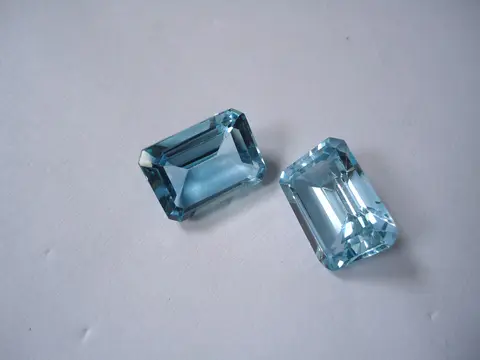
Natural topaz is rarely more than pale blue; the saturated blues on the market come from treatment, which keeps blue topaz inexpensive. See topaz value for the species as a whole.
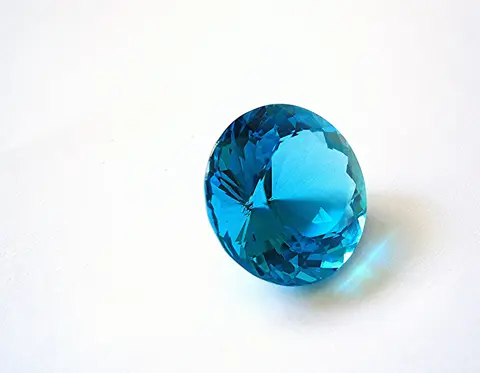
- Even, saturated blue in large clean stones points to treated topaz.
- Heavy in the hand for its size (SG 3.5).
- Weak dichroism.
- Cleavage cracks may appear parallel to the table.
Where blue topaz comes from
- Minas Gerais, Brazil
- Main supply of colorless rough for treatment.
- Nigeria, Sri Lanka and China
- Other large sources of treatment rough.
- Urals, Russia and Ukraine
- Natural pale blue crystals for collectors.
Fake, dyed and treated blue topaz
Blue glass
Common
- Bubbles
- Light (SG about 2.5)
Synthetic blue spinel
Occasional
- No dichroism
- SG 3.6, very close, so needs RI
Blue-coated colorless topaz
Occasional
- Color worn at facet edges
Is my blue topaz real? Tests you can do at home
-
Specific gravity
Use water displacement with a 0.01 g scale.
- Real
- About 3.53.
- Fake or lookalike
- Aquamarine 2.7, glass about 2.5, zircon 4.7.
-
Loupe check of facet edges
Inspect facet junctions and the pavilion with a 10x loupe.
- Real
- Crisp edges with color through the whole stone.
- Fake or lookalike
- Coatings show colorless patches where worn; glass has rounded edges.
A stone that passes these tests is consistent with natural blue topaz, not proven. For valuable pieces, a gem lab report settles treatment and origin.
Treatments
- Irradiation plus heating (almost always)
- Creates stable blue; the reason blue topaz is plentiful and low priced. Assume treated; labs can sometimes confirm.
What moves the price of blue topaz
- Shade. London blue usually costs a little more than Swiss, and Swiss more than sky.
- Cut and size. Labor and setting are often a larger part of the cost than the stone itself.
- Natural color. Documented natural blue topaz is a collector item worth much more than treated.
Questions collectors ask about blue topaz
- Why is blue topaz so cheap?
- Colorless topaz is abundant and can be turned blue by irradiation and heating, so the supply of blue topaz is nearly unlimited. Natural saturated blue topaz is rare, but almost none of it reaches the jewelry market.
- Is a blue topaz rare?
- Treated blue topaz is very common. Natural topaz with a strong blue color is rare and is usually sold as a mineral specimen.
- Is blue topaz worth anything?
- It has modest value as a gem, mostly set by size, cut and shade, with London blue typically above Swiss and sky blue. See the price table above for current ranges.
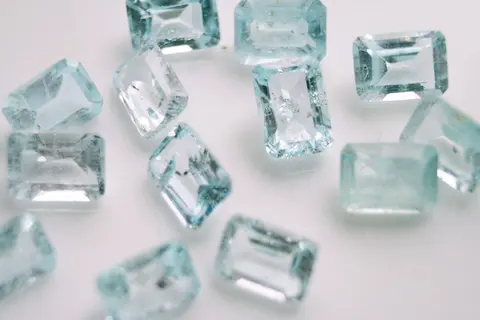
- Aquamarine vs blue topaz: how can you tell?
- Blue topaz is much heavier (SG 3.53 against 2.7) and usually a more vivid blue. Aquamarine tends toward a softer, slightly greenish blue and is more expensive at similar color.