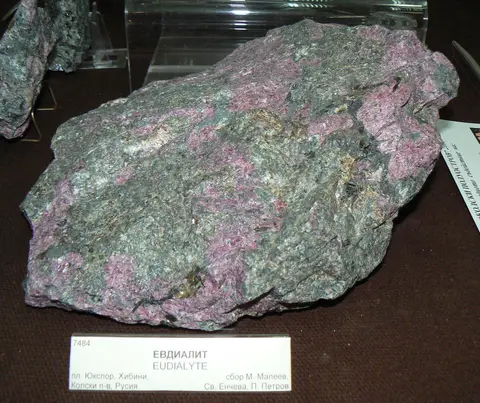
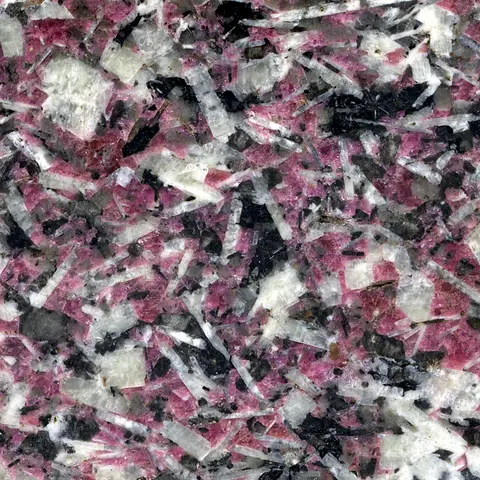
Eudialyte is a complex sodium calcium zirconium silicate with iron, manganese and chlorine, found in nepheline syenite and other alkaline igneous rocks. Most eudialyte on the market is a rock of raspberry red eudialyte grains mixed with black aegirine and white feldspar or nepheline.
These are dealer asking prices: what shops list eudialyte for, not what it sells for and not an appraisal. Selling to a dealer usually brings well below retail, because the dealer has to resell it at a margin.
How to identify eudialyte
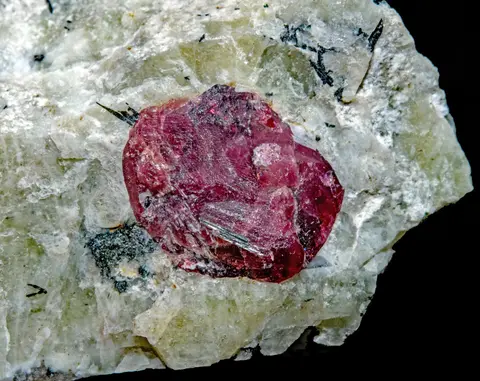
Raspberry red, pink or brownish red grains or masses in a speckled rock.
Usually accompanied by black needles or grains of aegirine and white to gray feldspar or nepheline.
Hardness 5 to 5.5: a steel knife scratches it, it does not scratch glass.
Vitreous to greasy luster on broken surfaces.
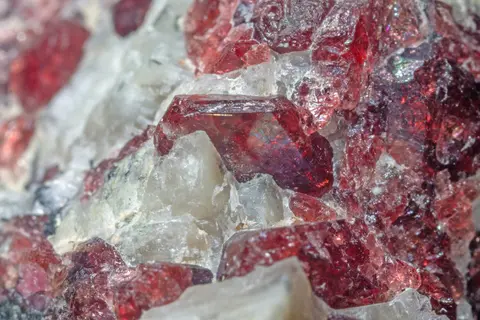
Rare well formed crystals are trigonal, tabular or rhombohedral.
No strong cleavage; uneven fracture.
Where eudialyte comes from
Kola Peninsula, Russia
Lovozero and Khibiny massifs; source of much tumbled and slab material.
Southern Greenland
Ilimaussaq complex near Narsaq, the type region, and Kangerlussuaq.
Jasper is uniformly fine grained, harder (6.5 to 7) and scratches glass.
No black crystal grains
Fake, dyed and treated eudialyte
Other red speckled rocks sold as eudialyte
Occasional
Red part scratches glass (garnet or jasper)
Matrix lacks black aegirine needles
Waxed or resin-stabilized tumbled stones
Occasional
Uniform glossy coating
Fills pits in softer grains
Is my eudialyte real? Tests you can do at home
Steel and glass scratch
Try a steel nail on a red grain, then press the red grain against glass.
Real
Steel scratches the red grains; they do not scratch glass.
Fake or lookalike
Garnet and jasper scratch glass and resist steel.
Can leave a small mark.
Loupe on the matrix
Examine the rock with a 10x loupe.
Real
Red grains with black aegirine needles and white feldspar or nepheline.
Fake or lookalike
Uniform red jasper or garnet in mica schist.
Specific gravity by water displacement
Weigh dry and suspended in water on a kitchen scale.
Real
Whole rock around 2.7 to 3.0.
Fake or lookalike
Garnet-rich rock reads higher.
A stone that passes these tests is consistent with natural eudialyte, not proven. For valuable pieces, a gem lab report settles treatment and origin.
Treatments
Waxing or stabilization (occasional)
Improves polish on tumbled and cabochon material where minerals of different hardness undercut. Even glossy film over all grains; lab only for certainty.
What moves the price of eudialyte
Proportion of red. More bright raspberry eudialyte and less matrix is worth more.
Color. Vivid pink to red rather than brownish.
Crystals. Distinct crystals are rare and sought by collectors.
Locality. Greenland and Mont Saint-Hilaire specimens have collector premiums.
Polish quality. Even, undercut-free polish on cabochons and spheres.
Sources
Prices: 2 current listings from FossilEra, seen 2026-11-20 to 2026-11-20. How we collect prices.