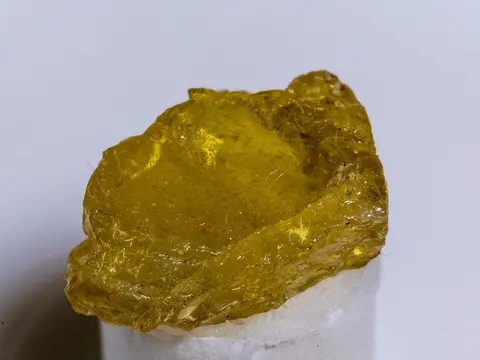
What sinhalite is worth
Not enough data. We have not yet seen 5 or more current dealer listings for sinhalite in any one form, so we show no range rather than guess.
These are dealer asking prices: what shops list sinhalite for, not what it sells for and not an appraisal. Selling to a dealer usually brings well below retail, because the dealer has to resell it at a margin.
How to identify sinhalite
- Yellow, golden brown, greenish brown or dark brown color
- Strong doubling of back facet edges under a loupe (high birefringence)
- Noticeable pleochroism: shades of green-brown, brown and pale brown in different directions
- Mostly found as water-worn pebbles in gem gravels; good crystals are rare
- Vitreous luster and no visible cleavage
- Hard enough to scratch glass easily
Where sinhalite comes from
- Ratnapura and other gem gravels, Sri Lanka
- Type locality and main source of faceted stones, some quite large.
- Mogok, Myanmar
- Found in gem gravels alongside many other gem species.
- Handeni district, Tanzania
- Source of pinkish to brownish material.
- Warren County, New York, USA
- Non-gem grains in skarn rocks, of interest to systematic collectors.
Sinhalite lookalikes
Peridot is lighter (SG about 3.3 to 3.4) and has a lower refractive index (1.65 to 1.69); its color is usually a purer green.
- Both show strong doubling
- Peridot often has lily pad inclusions
- Brown peridot is rare, while brown is normal for sinhalite
Chrysoberyl is harder (8.5), heavier (about 3.7) and shows little doubling.
- Chrysoberyl RI 1.74 to 1.76
Zircon is much heavier (SG 4.6 to 4.7), with adamantine luster and strong fire.
- Zircon RI 1.92 to 1.98
- Strong doubling as well
Tourmaline is lighter (about 3.06) and has a lower refractive index (1.62 to 1.65).
- Tourmaline birefringence about 0.018 to 0.020, about half that of sinhalite
Also mistaken for sinhalite: kornerupine.
Fake, dyed and treated sinhalite
Sinhalite sold as brown peridot, or peridot sold as sinhalite
Occasional
- Refractive index and specific gravity separate them
- Older parcels from Sri Lanka may still carry the peridot label
Brown glass
Rare
- No doubling of facet edges
- Bubbles or swirls under a loupe
- No pleochroism
Is my sinhalite real? Tests you can do at home
-
Loupe for doubling
Look through the table at the back facet edges with a 10x loupe.
- Real
- Back facet edges appear clearly doubled.
- Fake or lookalike
- Glass, chrysoberyl and most garnets show no doubling.
-
Specific gravity with a kitchen scale
Weigh dry, then suspended in water; divide dry weight by the loss in water. Use a scale reading to 0.01 g.
- Real
- About 3.47 to 3.50.
- Fake or lookalike
- Peridot about 3.3, tourmaline about 3.06, zircon about 4.7.
-
Scratch test on rough
On rough only, drag a sharp edge across a glass slide.
- Real
- Scratches glass.
- Fake or lookalike
- Glass imitations may fail to scratch.
Can leave a small mark.
A stone that passes these tests is consistent with natural sinhalite, not proven. For valuable pieces, a gem lab report settles treatment and origin.
Treatments
- None known as routine (rare)
- Sinhalite is sold untreated. Laboratory testing if in doubt.
What moves the price of sinhalite
- Identification. A confirmed sinhalite with a lab report is valued as a collector stone; unconfirmed brown stones sell as generic.
- Size. Clean stones over several carats are scarce and sought by rare gem collectors.
- Color. Bright golden to greenish brown is preferred over dark, muddy brown; pinkish stones are unusual.
- Clarity. Eye-clean stones rank above included ones.
- Cut quality. Well-proportioned cutting that shows brightness despite the strong doubling adds appeal.