RockValues

Ekanite value and identification

Ekanite is a rare calcium thorium silicate (Ca2ThSi8O20) found as a gem mainly in the gravels of Sri Lanka. Its thorium makes it radioactive, and that radiation usually breaks down its crystal structure (a metamict state).

Prices checked . Page updated .
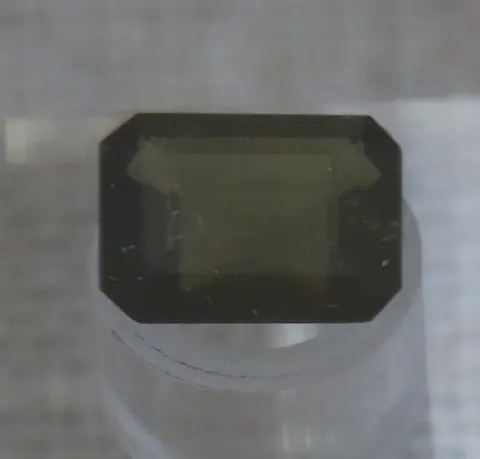
Ekanite: Cut crystal of Ekanite
Cut crystal of Ekanite. Photo: Geni, CC BY-SA 4.0, via Wikimedia Commons.

What ekanite is worth

Not enough data. We have not yet seen 5 or more current dealer listings for ekanite in any one form, so we show no range rather than guess.

These are dealer asking prices: what shops list ekanite for, not what it sells for and not an appraisal. Selling to a dealer usually brings well below retail, because the dealer has to resell it at a margin.

How to identify ekanite

  • Green, yellow-green to brown, usually transparent to translucent when cut.
  • Some cabochons show a four-rayed star.
  • Shows no doubling of facets under a loupe because the metamict structure is nearly isotropic.
  • Moderately heavy for its size (SG about 3.3).
  • Registers on a Geiger counter.
  • Almost always offered as cut stones from Sri Lanka rather than crystals.

Where ekanite comes from

Sri Lanka
Gem gravels near Ratnapura produce nearly all gem ekanite; the mineral was described from Sri Lanka in the 1950s and named after F. L. D. Ekanayake.

Ekanite lookalikes

Green (low) zircon

Low zircon is heavier and has much higher luster.

  • SG about 3.9 to 4.1
  • RI well above 1.8

Peridot

Peridot shows strong doubling of back facets under a loupe.

  • SG about 3.3, similar to ekanite
  • RI 1.65 to 1.69
  • Not radioactive

Green tourmaline

Tourmaline is lighter and strongly pleochroic.

  • SG about 3.06
  • Hardness 7 to 7.5

Fake, dyed and treated ekanite

  • Other green Sri Lankan gems labeled ekanite

    Occasional

    • Needs RI, SG and radioactivity checks; buy with a lab report
  • Green glass

    Rare

    • Bubbles
    • Not radioactive
    • SG usually lower

Is my ekanite real? Tests you can do at home

  1. Geiger counter check

    Hold a consumer Geiger counter near the stone and compare with background.

    Real
    Reads above background.
    Fake or lookalike
    Peridot, tourmaline and glass read as background.
  2. Loupe doubling test

    Look through the table at back facets with a 10x loupe.

    Real
    No doubling.
    Fake or lookalike
    Peridot and high zircon show clear doubling.
  3. Specific gravity with a kitchen scale

    For loose stones, weigh in air and suspended in water, then divide air weight by weight loss. Small stones need a carat scale.

    Real
    About 3.3.
    Fake or lookalike
    Zircon near 4; tourmaline about 3.06; glass varies.

A stone that passes these tests is consistent with natural ekanite, not proven. For valuable pieces, a gem lab report settles treatment and origin.

Treatments

None known (rare)
Ekanite is sold untreated. Not needed.

What moves the price of ekanite

  1. Rarity and documentation. A lab report confirming ekanite adds confidence and value.
  2. Phenomena. Star ekanite is the most sought after.
  3. Color and clarity. Brighter green and cleaner stones bring more.
  4. Size. Larger stones are scarce.
  5. Cut. Well-centered stars and clean cutting.

Care and safety

Ekanite is radioactive. Store it in a closed box away from where people sit or sleep, do not wear it as everyday jewelry, and wash hands after handling.

Sources

Prices: no current dealer listings yet. How we collect prices.