RockValues

Actinolite value and identification

Actinolite is a green calcium magnesium iron silicate of the amphibole group, forming bladed, needle-like or fibrous crystals. A dense, felted form of tremolite and actinolite is nephrite jade.

Prices checked . Page updated .

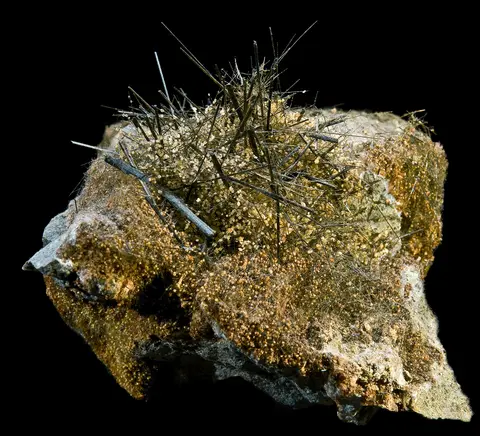
Actinolite: Actinolite Portugal
Actinolite Portugal. Photo: Didier Descouens, CC BY-SA 4.0, via Wikimedia Commons.
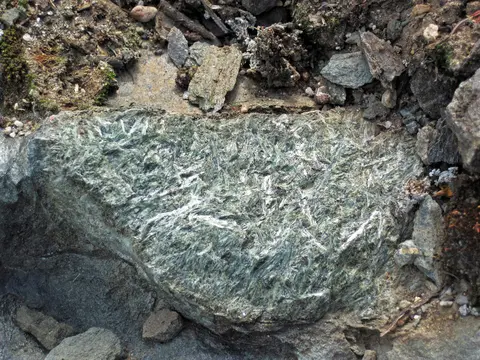
Actinolite: Actinolite xenolith in sandorite lamprophyre (Sandor Dike, Neoarchean, 2.703 Ga; Route 17 roadcut northeast of Wasp Lake & north of Wawa, Ontario, Canada) 10 (48342712757)
Actinolite xenolith in sandorite lamprophyre (Sandor Dike, Neoarchean, 2.703 Ga; Route 17 roadcut northeast of Wasp Lake & north of Wawa, Ontario, Canada) 10 (48342712757). Photo: James St. John, CC BY 2.0, via Wikimedia Commons.
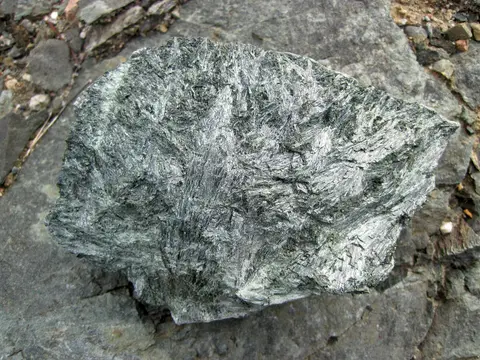
Actinolite: Actinolite xenolith & sandorite lamprophyre (Sandor Dike, Neoarchean, 2.703 Ga; Route 17 roadcut northeast of Wasp Lake & north of Wawa, Ontario, Canada) 15 (48343305237)
Actinolite xenolith & sandorite lamprophyre (Sandor Dike, Neoarchean, 2.703 Ga; Route 17 roadcut northeast of Wasp Lake & north of Wawa, Ontario, Canada) 15 (48343305237). Photo: James St. John, CC BY 2.0, via Wikimedia Commons.
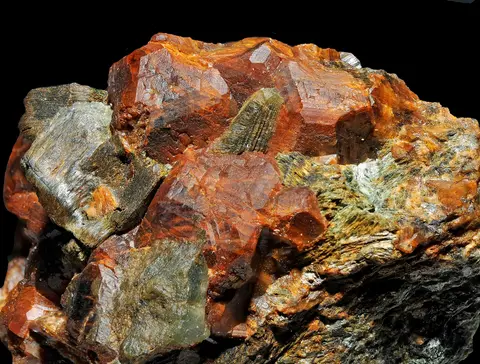
Actinolite: Almandin, actinolite 300-3-FS
Almandin, actinolite 300-3-FS. Photo: Parent Géry, CC BY-SA 3.0, via Wikimedia Commons.

What actinolite is worth

Not enough data. We have not yet seen 5 or more current dealer listings for actinolite in any one form, so we show no range rather than guess.

Show 2 of the listings behind these numbers
Sample dealer listings for Actinolite
ListingSizeLocalityAskingSeen
1.2" Shimmering Green Actinolite Specimen - California
FossilEra
3.1 cmCalifornia$19
1.25" Shimmering Green Actinolite Specimen - California
FossilEra
3.2 cmCalifornia$25

These are dealer asking prices: what shops list actinolite for, not what it sells for and not an appraisal. Selling to a dealer usually brings well below retail, because the dealer has to resell it at a margin.

How to identify actinolite

  • Green to dark green, long bladed or needle-like crystals, often in radiating sprays.
  • Two cleavage directions meeting at about 56 and 124 degrees, giving a diamond-shaped cross section.
  • Vitreous luster on crystals, silky in fibrous masses.
  • Hardness 5 to 6: about as hard as a knife blade.
  • Common as green needles inside quartz and as crystals in talc or schist.
  • Darker green and heavier than its iron-poor relative tremolite.

Where actinolite comes from

Zillertal, Tyrol, Austria
Classic long green blades in talc schist from the Greiner area.
Brazil
Supplies most quartz with green actinolite needles sold in shops.
British Columbia, Canada, and other nephrite districts
Compact actinolite and tremolite forms nephrite jade.

Actinolite lookalikes

Tremolite

Tremolite is white, gray or pale green; actinolite is deeper green from iron.

  • Same structure, end member with little iron
  • Lower SG, about 2.9 to 3.0

Epidote

Epidote is pistachio to yellow-green and has one perfect cleavage.

  • Hardness 6 to 7
  • SG about 3.4

Green tourmaline

Tourmaline has a rounded triangular cross section and no good cleavage.

  • Hardness 7 to 7.5
  • Striated prisms

Green kyanite

Kyanite blades are flat and harder across than along their length.

  • Hardness 4.5 to 7 depending on direction

Nephrite jade

Nephrite is the tough, compact, felted form of tremolite-actinolite rather than visible crystals.

  • Same mineral family

Also mistaken for actinolite: black kyanite.

Fake, dyed and treated actinolite

  • Fiber-optic glass sold as cat's-eye actinolite

    Occasional

    • Honeycomb pattern seen from the side or base with a loupe
    • Perfectly sharp, unnaturally bright eye
  • Other green needles in quartz labeled actinolite

    Occasional

    • Chlorite, epidote or tourmaline inclusions look similar; color and needle shape differ

Is my actinolite real? Tests you can do at home

  1. Cleavage angle check

    Look at the end of a broken crystal with a loupe.

    Real
    Diamond-shaped cross section from cleavages at about 56 and 124 degrees.
    Fake or lookalike
    Tourmaline shows a rounded triangle; epidote a single cleavage.
  2. Glass scratch test

    Try a crystal point against glass.

    Real
    Barely scratches or just fails to scratch glass.
    Fake or lookalike
    Tourmaline scratches glass easily.

    Can leave a small mark.

  3. Loupe on cat's-eye stones

    Look at the side or base of a cat's-eye cabochon at 10x.

    Real
    Irregular fibers.
    Fake or lookalike
    Fiber-optic glass shows a regular honeycomb grid.

A stone that passes these tests is consistent with natural actinolite, not proven. For valuable pieces, a gem lab report settles treatment and origin.

Treatments

None usual (rare)
Specimens and cut stones are generally untreated. Not usually needed.

What moves the price of actinolite

  1. Crystal quality. Long, sharp, lustrous blades or well-formed sprays.
  2. Locality. Classic Alpine specimens bring premiums.
  3. Inclusion aesthetics. In quartz, clear host with well-spread green needles.
  4. Gem quality. Transparent faceted actinolite and sharp cat's-eye stones are rare collector pieces.
  5. Damage. Blades break easily along cleavage; broken tips reduce value.

Care and safety

Fibrous (asbestiform) actinolite is a type of asbestos. Do not break, sand or grind fibrous material, and keep dust out of the air; solid crystals and actinolite in quartz are not a concern when handled normally.

Sources

Prices: 2 current listings from FossilEra, seen 2026-11-20 to 2026-11-20. How we collect prices.