What nuummite is worth
Not enough data. We have not yet seen 5 or more current dealer listings for nuummite in any one form, so we show no range rather than guess.
These are dealer asking prices: what shops list nuummite for, not what it sells for and not an appraisal. Selling to a dealer usually brings well below retail, because the dealer has to resell it at a margin.
How to identify nuummite
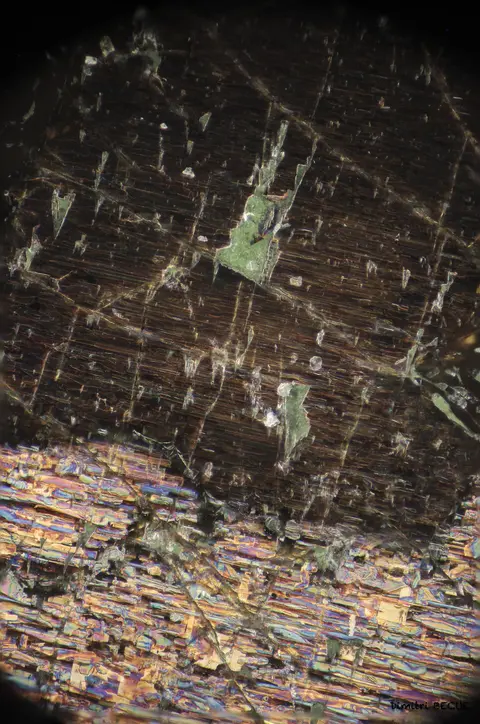
- Black to dark gray body with fibrous or bladed crystals that flash gold, bronze, coppery or blue as the stone is tilted.
- Flashes come from aligned amphibole blades, so they appear as streaks and patches rather than a single sheen.
- May contain small brassy pyrite or pyrrhotite specks.
- Moderately hard: a steel knife has difficulty scratching it.
- Feels somewhat heavier than quartz.
- Usually sold polished as cabochons, spheres and palm stones.
Where nuummite comes from
- Nuuk region, Greenland
- The only source of true nuummite; the name comes from Nuuk. Export is limited, which keeps supply small.
Nuummite lookalikes
Astrophyllite forms brassy golden radiating blades in a lighter matrix.
- Hardness about 3
- Bright metallic gold blades rather than dark flashing body
nuummite vs astrophyllite
Larvikite shows blue-silver schiller in broad feldspar crystals, not fibrous gold streaks.
- Gray igneous rock from Norway
- Hardness 6 to 6.5
larvikite vs nuummite
Black tourmaline has no flash and is striated along its length.
black tourmaline vs nuummite
Arfvedsonite
Arfvedsonite is a sodium amphibole with blue-black sheen but lacks nuummite's golden flashes.
- Sometimes sold as or alongside nuummite
Hypersthene shows a uniform bronze schiller across the stone.
Fake, dyed and treated nuummite
Other dark amphibole rocks sold as nuummite
Common
- No Greenland source given
- Uniform sheen instead of patchy gold and blue flashes
- Unusually large, cheap pieces
Larvikite or hypersthene labeled nuummite
Occasional
- Broad feldspar schiller or even bronze sheen
Is my nuummite real? Tests you can do at home
-
Tilt and flash check
Rotate the polished stone under a single bright light.
- Real
- Patchy streaks of gold, bronze and sometimes blue appear along fibrous blades.
- Fake or lookalike
- Larvikite shows broad blue-silver flashes; hypersthene a uniform bronze.
-
Loupe on texture
Look at the surface at 10x.
- Real
- Interlocking fibrous and bladed amphibole crystals.
- Fake or lookalike
- Larvikite shows large blocky feldspar crystals.
-
Knife test on an unpolished spot
Try a steel knife on the back or a rough area.
- Real
- Hard to scratch.
- Fake or lookalike
- Astrophyllite and soft imitations scratch easily.
Can leave a small mark.
A stone that passes these tests is consistent with natural nuummite, not proven. For valuable pieces, a gem lab report settles treatment and origin.
Treatments
- None usual (rare)
- Nuummite is generally sold untreated; polish brings out the flash. Not usually needed.
What moves the price of nuummite
- Flash. Abundant, bright gold and blue flashes across the whole face.
- Origin. Documented Greenland material is what buyers pay for.
- Finish. A high polish without pits or undercutting.
- Size. Larger polished pieces with even flash.
- Inclusions and cracks. Fractures and dull patches lower value.
Questions collectors ask about nuummite
- What is nuummite?
- Nuummite is a metamorphic rock from the Nuuk area of Greenland made mostly of the amphiboles anthophyllite and gedrite, which flash gold and blue when polished.
- How rare is nuummite?
- It comes from a single region of Greenland where collection and export are limited, so supply is small compared with most polished stones.
- Why is nuummite called the sorcerer's stone?
- That is a marketing nickname from the metaphysical crystal trade, not a mineralogical name.