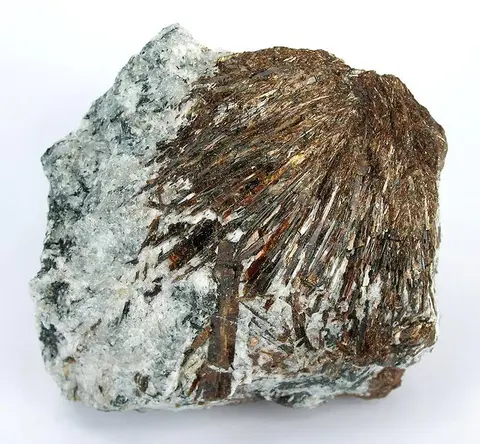
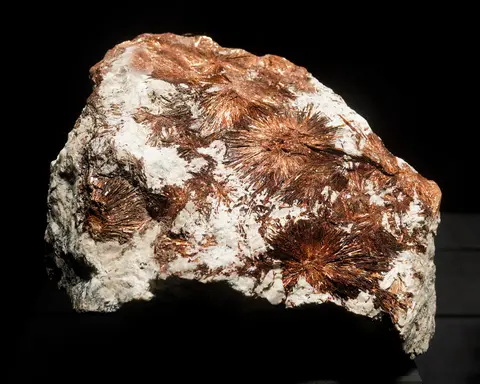
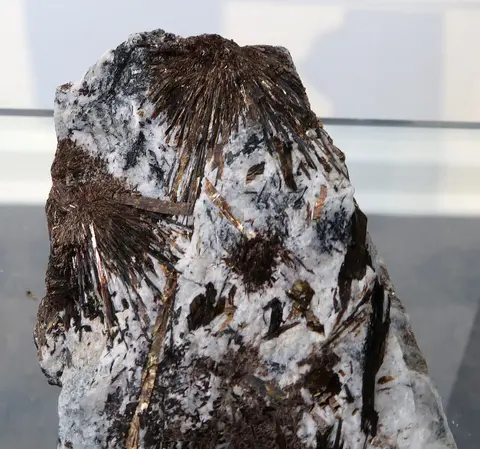
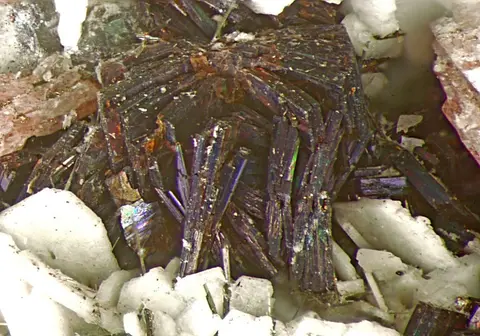
Astrophyllite is a potassium, sodium, iron and titanium silicate that grows as brittle, bronze to golden blades, often in star-shaped sprays. It forms in nepheline syenites and alkali granites and their pegmatites.
These are dealer asking prices: what shops list astrophyllite for, not what it sells for and not an appraisal. Selling to a dealer usually brings well below retail, because the dealer has to resell it at a margin.
How to identify astrophyllite
Bronze, golden yellow or brown blades with a submetallic to pearly sheen
Blades often radiate in star-like sprays, the origin of the name (Greek for star and leaf)
Perfect cleavage into thin flakes like mica, but the flakes are brittle and snap instead of bending
Commonly set in white to gray feldspar, often with black aegirine or arfvedsonite needles
Soft: hardness about 3, scratched by a copper coin edge or knife
Golden streak
Where astrophyllite comes from
Khibiny Massif, Kola Peninsula, Russia
Main commercial source of polished slabs, cabochons and tumbled stones with golden sprays in feldspar.
Langesundsfjord, Norway
Type area, on Laven island and near Brevik, in syenite pegmatites.
St. Peters Dome, El Paso County, Colorado, USA
Golden blades with zircon and riebeckite in pegmatites near Pikes Peak.
Mont Saint-Hilaire, Quebec, Canada
Well-formed crystals among the many rare alkaline minerals of this quarry.
Ilimaussaq intrusion, Greenland
Occurs in the alkaline rocks of southern Greenland.
Flakes stack in books rather than radiating in blades
No golden streak
Astrophyllite, nuummite and arfvedsonite mixed up in listings
Common
Nuummite is a dark rock with fibrous flash
Arfvedsonite is black
Astrophyllite is bronze blades, usually in pale feldspar
Is my astrophyllite real? Tests you can do at home
Flake flexibility
On rough material, lift the edge of a loose cleavage flake with a pin and bend it gently.
Real
The flake snaps or crumbles.
Fake or lookalike
Mica flakes bend and spring back.
Can leave a small mark.
Streak plate
Rub an inconspicuous corner on the back of an unglazed ceramic tile.
Real
Golden yellow streak.
Fake or lookalike
Biotite gives a white to gray streak; arfvedsonite a bluish gray one.
Can leave a small mark.
Loupe on the habit
Examine the metallic blades with a 10x loupe.
Real
Flat, bladed crystals, often radiating, with pearly bronze cleavage faces.
Fake or lookalike
Nuummite shows fine fibers; mica shows stacked hexagonal sheets.
A stone that passes these tests is consistent with natural astrophyllite, not proven. For valuable pieces, a gem lab report settles treatment and origin.
Treatments
Resin stabilization of slabs and cabochons (occasional)
Soft, cleavable blades can lift during polishing, so some material is impregnated to hold it together; stabilized pieces are normal in this trade but less desirable to purists. Glassy, plastic-like surface over the blades and lack of the slight undercut normal on soft blades.
What moves the price of astrophyllite
Pattern. Clear, bright star-shaped sprays on contrasting white feldspar are preferred.
Specimen quality. For mineral specimens, well-formed blades or sprays standing on matrix from classic localities draw more interest than massive material.
Locality. Material from Mont Saint-Hilaire, St. Peters Dome or Norway is collected for its origin; Kola material dominates the lapidary market.
Finish. Polished pieces without lifted or pitted blades are worth more.
Size. Larger sprays and bigger slabs are less common.
Sources
Prices: 4 current listings from Dakota Matrix Minerals, FossilEra, seen 2026-11-20 to 2026-11-20. How we collect prices.