Black obsidian vs tourmaline
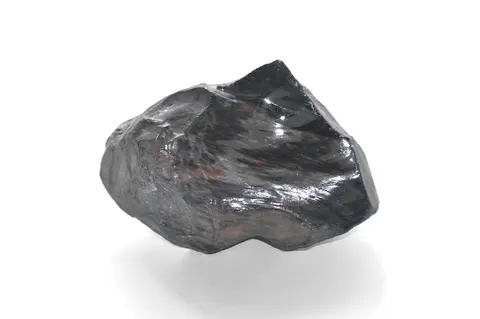
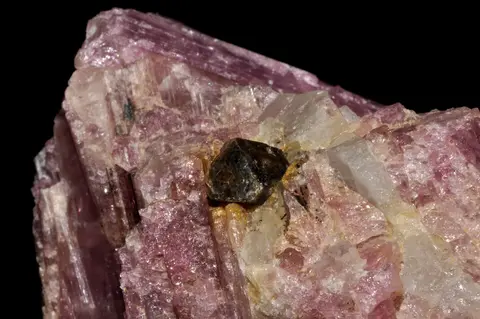
Obsidian has smooth curved shell-like breaks and no crystal faces or striations; black tourmaline grows as striated prisms.
Side by side
| Property | Black obsidian | Tourmaline |
|---|---|---|
| Hardness (Mohs) | 5 to 5.5 | 7 to 7.5 |
| Specific gravity | 2.35 to 2.60 | 3.0 to 3.26 (elbaite near 3.05, schorl near 3.2) |
| Luster | Vitreous (glassy) | Vitreous |
| Streak | White | White to gray (schorl can give a pale gray to bluish gray streak) |
| Crystal system | Amorphous (no crystal structure) | Trigonal |
| Cleavage | None | Indistinct |
| Refractive index | 1.48 to 1.51 | 1.62 to 1.65, birefringence about 0.018 to 0.020 |
| Formula | Amorphous glass, mostly SiO2 with aluminum, sodium, potassium and minor iron | General formula XY3Z6(T6O18)(BO3)3V3W; for example elbaite Na(Li1.5Al1.5)Al6(Si6O18)(BO3)3(OH)3(OH) and schorl NaFe3Al6(Si6O18)(BO3)3(OH)3(OH) |
| Typical dealer asking price | Not enough data | $19 to $1,263 (specimens) |
How to tell them apart
- Obsidian hardness 5 to 5.5 vs tourmaline 7 to 7.5
- Obsidian SG 2.35 to 2.6 vs schorl about 3.2
- Obsidian is volcanic glass with no crystal shape
Photos of each
Black obsidian

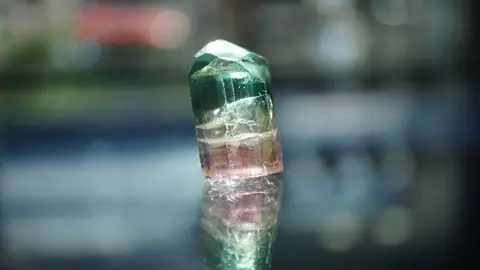
Tourmaline


More on each: black obsidian value and identification and tourmaline value and identification.