What amber is worth
By variety
Show 12 of the listings behind these numbers
These are dealer asking prices: what shops list amber for, not what it sells for and not an appraisal. Selling to a dealer usually brings well below retail, because the dealer has to resell it at a margin.
How to identify amber
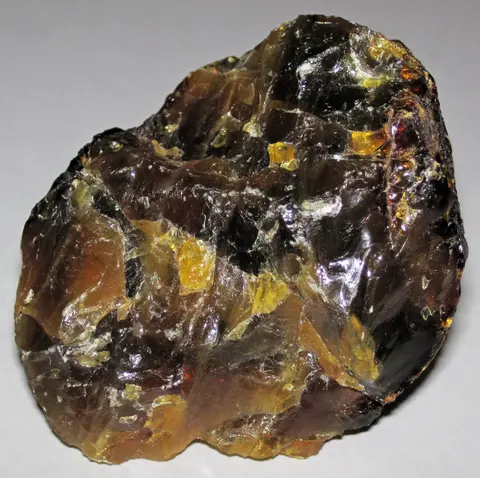
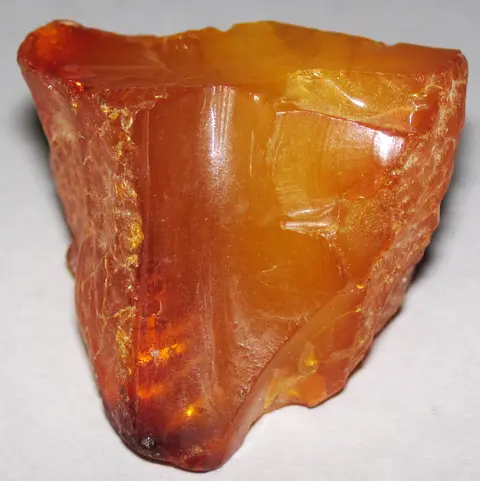
Amber is fossilized tree resin, an organic gem made of hardened hydrocarbon polymers rather than a mineral, typically tens of millions of years old. It is light, warm to the touch, soft, and comes mostly in yellow, orange and brown.
- Very light in the hand: a piece the size of a walnut feels almost weightless compared with glass or stone.
- Warm to the touch, never cold like glass or quartz.
- Resinous luster and soft surface (hardness 2 to 2.5); old pieces show fine surface crazing and a slightly dull skin.
- Floats in saturated salt water (SG about 1.05 to 1.10).
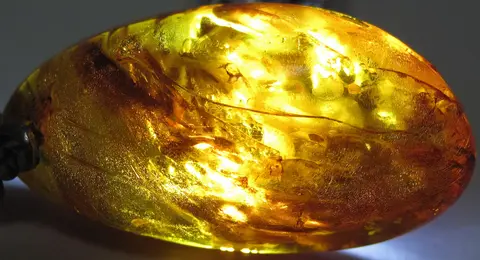
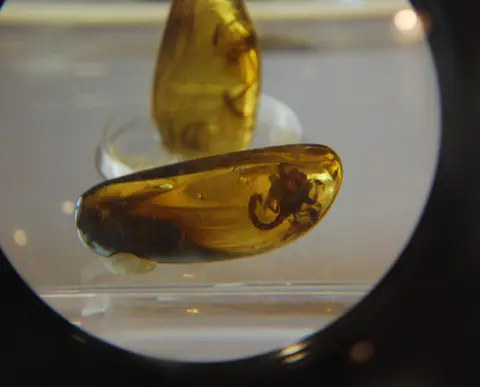
- Natural inclusions: tiny air bubbles, plant debris, flow lines, and occasionally insects in natural poses.
- Fluoresces bluish white, yellowish or green under a long-wave UV torch, often strongly on a fresh surface.
- Rubbed briskly on wool or cotton, it becomes electrically charged and lifts tiny bits of paper.
Amber varieties
Burmese amber
Burmese amber, or burmite, comes from the Hukawng Valley in Kachin State, Myanmar, and is about 99 million years old (Cretaceous). It is older and slightly harder than Baltic or Dominican amber, often reddish brown, and its dinosaur-age inclusions are scientifically important; its trade is tied to conflict in the region and many researchers avoid it.
Dominican amber
Dominican amber is Miocene amber from the northern mountains of the Dominican Republic, known for clarity, abundant insect inclusions and blue fluorescence. It is younger than Baltic amber, contains no significant succinic acid, and comes from a different tree (the extinct legume Hymenaea protera).
Mexican amber
Mexican amber is Miocene amber from Chiapas, especially around Simojovel, ranging from yellow to red with some green and blue fluorescing pieces. Similar in age and source tree to Dominican amber, it is often harder to polish and typically more orange to red than Baltic material.
Where amber comes from
- Baltic Sea coast (Kaliningrad, Poland, Lithuania)
- Largest source of gem amber, Eocene in age; the Yantarny mine in Kaliningrad supplies most of the world's raw amber, and Gdansk is the main working center.
- Dominican Republic
- Miocene amber from the Cordillera Septentrional, often very clear, famous for insect inclusions and blue amber.
- Chiapas, Mexico
- Miocene amber around Simojovel, yellow to red with some blue and green fluorescence.
- Kachin State, Myanmar
- Cretaceous amber (about 99 million years old) with important fossil inclusions; trade is affected by conflict and ethical concerns.
- Rivne region, Ukraine
- Baltic-type amber from deposits inland.
- Sumatra, Indonesia
- Younger amber with blue to green fluorescence.
Amber lookalikes
Copal
Copal is younger, less polymerized resin; a drop of acetone on a hidden spot makes copal tacky while amber is unaffected.
- Copal also floats in salt water
- Copal often has a fresher, sharper resin smell and may crack or craze quickly
- Copal is softer and can be dented with a fingernail on fresh pieces
Citrine is cold to the touch, much heavier and scratches glass.
- Citrine hardness 7
- Citrine SG 2.65
- Citrine sinks in water
citrine vs amber
Carnelian is cold, heavy for its size and too hard to scratch with a knife.
- Hardness 6.5 to 7
- SG 2.6
- Waxy rather than resinous luster
carnelian vs amber
Fire opal is cold, sinks in salt water and is harder.
- Hardness 5.5 to 6.5
- SG about 2.0
gem lites fire opal vs amber
Also mistaken for amber: honey calcite, sphalerite.
Fake, dyed and treated amber
Plastic and phenolic resin sold as amber
Very common
- Sinks in saturated salt water (most plastics)
- Hot point gives an acrid chemical smell instead of pine resin
- Perfectly uniform color or regular bubbles
- Little or no fluorescence, or a different color under UV
Copal sold as amber
Very common
- Acetone or nail polish remover makes the surface tacky
- Insects look modern and perfectly preserved
- Surface crazes or cracks over time
Glass sold as amber
Common
- Cold to the touch
- Much heavier
- Hard enough to scratch other surfaces
Pressed amber (ambroid)
Common
- Elongated, flattened bubbles
- Grainy or swirled flow structure along boundaries of fused chips
- Very uniform color across beads
Heat-clarified amber with sun spangles
Very common
- Disc-shaped stress fractures that flash gold
- Unusually clear cognac color
Inserted insects in drilled or split amber
Occasional
- A seam, plane or drill channel near the insect
- Insect that is too large or perfectly posed
- Copal or plastic around the insect
Is my amber real? Tests you can do at home
-
Salt water float test
Stir salt into a glass of warm water until no more dissolves, let it cool, then drop the piece in (remove metal fittings first).
- Real
- Amber floats or hovers near the surface.
- Fake or lookalike
- Glass and most plastics sink; copal also floats, so this test alone does not rule out copal.
-
Acetone drop test
Put one drop of acetone or nail polish remover on a hidden spot, wait about 20 seconds, then touch it.
- Real
- Surface stays hard and smooth.
- Fake or lookalike
- Copal and some plastics become sticky or soften.
Can leave a small mark.
-
Long-wave UV torch
In a dark room, shine a 365 nm UV torch on the piece.
- Real
- Glows bluish white, yellow or green, often brighter on fresh surfaces.
- Fake or lookalike
- Glass and many plastics show little or no glow, or an even, artificial glow.
-
Static test
Rub the piece briskly on wool or a cotton shirt for 30 seconds and hold it over tiny bits of tissue paper.
- Real
- Lifts the paper bits.
- Fake or lookalike
- Glass does not; some plastics also do, so use with other tests.
-
Hot needle test
Heat a needle tip and touch it to a hidden spot, holding the piece away from your face in a ventilated room.
- Real
- Gives off a piney resin smell and a small burned mark.
- Fake or lookalike
- Plastic smells acrid or chemical; copal melts quickly and smells sweeter.
Damages the stone: test only an inconspicuous spot or a piece you do not mind marking.
A stone that passes these tests is consistent with natural amber, not proven. For valuable pieces, a gem lab report settles treatment and origin.
Treatments
- Heat and pressure clarification (almost always)
- Removes cloudiness, deepens color, and creates decorative sun spangles; routine for Baltic amber jewelry and accepted when disclosed. Sun spangles and uniform clarity are visible; labs use infrared spectroscopy.
- Surface darkening and heating for color (common)
- Produces cherry, cognac and green colors; lowers value compared with natural color. Color confined to a thin surface layer seen at drill holes or chips.
- Reconstitution (pressing) (common)
- Fuses small amber chips into usable blocks; worth less than natural pieces. Flow structure and stretched bubbles under magnification.
- Coating and backing (occasional)
- Colored coatings or dark backings change face-up color, notably for green and blue amber. Color differs on chips and edges; coatings scratch off.
What moves the price of amber
- Inclusions. Identifiable insects, spiders, small vertebrates or plants, complete and well positioned, add the most value.
- Origin and age. Dominican blue amber and Burmese Cretaceous amber with scientific inclusions are valued above common material.
- Natural versus treated. Untreated, natural-color amber brings more than pressed, heat-darkened or coated pieces.
- Size. Large clean nuggets are scarce; most amber is small.
- Color and clarity. Even, attractive color; rare natural colors such as blue or butterscotch in antique beads.
- Antique status. Old Baltic butterscotch beads and carvings with verifiable age have their own collector market.
Care and safety
Do not test amber with a flame or hot point near your face; burning resin and plastic fumes are irritating.
Amber is soft and scratches easily; keep it away from perfume, hairspray, solvents and alcohol, and away from heat and long exposure to sun, which darken and craze it.
Questions collectors ask about amber
- How do I tell if amber is real?
- Real amber is warm and very light, floats in saturated salt water, glows under a long-wave UV torch and is not affected by a drop of acetone. Glass and most plastics sink, and copal turns sticky with acetone.
- How to tell fake amber from real amber?
- Combine the salt water float test with an acetone drop on a hidden spot: amber floats and stays hard, plastic and glass sink, and copal floats but goes tacky.
- How much is amber worth per gram?
- It varies widely with inclusions, origin, natural color and size; see the price table above for observed prices.
Sources
Prices: 35 current listings from Dave's Rock Shop, FossilEra, Throwin Stones, seen 2026-11-20 to 2026-11-20. How we collect prices.