Amber vs fire opal
Fire opal is cold, sinks in salt water and is harder.
Side by side
| Property | Amber | Fire opal |
|---|---|---|
| Hardness (Mohs) | 2 to 2.5 | 5.5 to 6.5 |
| Specific gravity | 1.05 to 1.10 | 1.98 to 2.25 (usually about 2.15) |
| Luster | Resinous | Vitreous to waxy or resinous |
| Streak | White | White |
| Crystal system | Amorphous | Amorphous (opal-A) to poorly crystalline (opal-CT) |
| Cleavage | None | None |
| Refractive index | About 1.54 | 1.37 to 1.47 (usually about 1.45; Mexican fire opal can be as low as 1.37) |
| Formula | Organic; mixture of polymerized terpenoid resins (roughly C10H16O), Baltic amber contains succinic acid | SiO2·nH2O |
| Typical dealer asking price | $1,390 to $17,342 (tumbled stones) | Not enough data |
How to tell them apart
- Hardness 5.5 to 6.5
- SG about 2.0
Photos of each
Amber
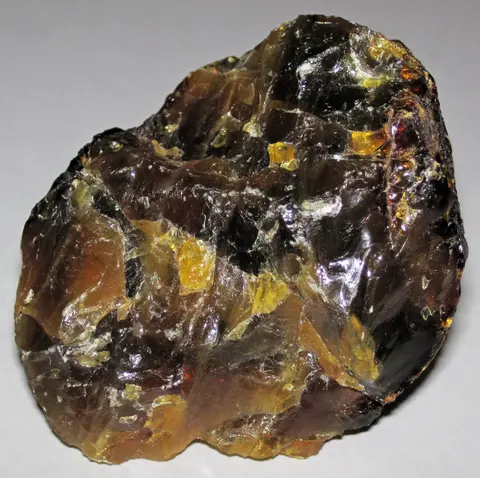

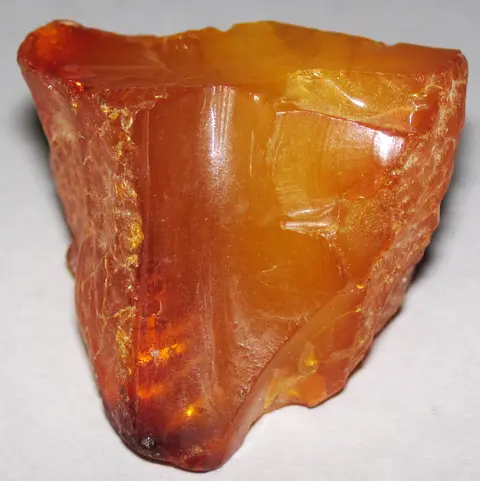

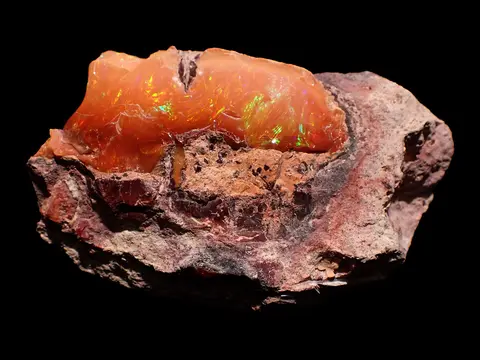
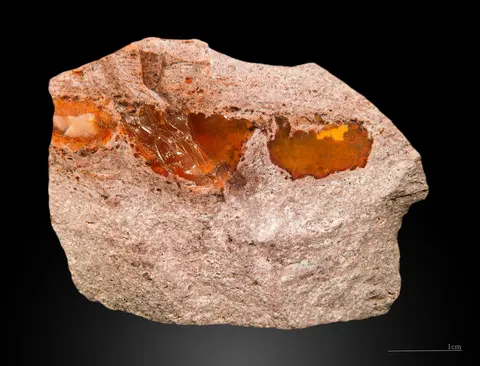
Fire opal


More on each: amber value and identification and fire opal value and identification.