RockValues

Tiger's eye value and identification

Dealers list tiger's eye tumbled stones at $20 to $155 per pound; rough runs about $7.50 to $9 per pound.

Prices checked . Page updated .
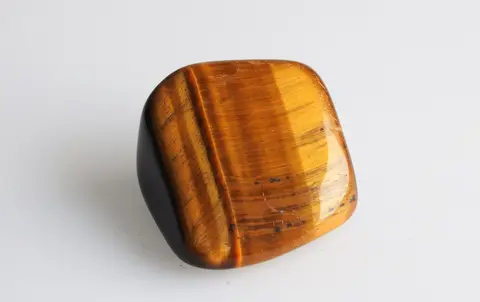
Tiger's eye: Tiger eye
Tiger eye. Photo: Weissanna, CC BY-SA 4.0, via Wikimedia Commons.
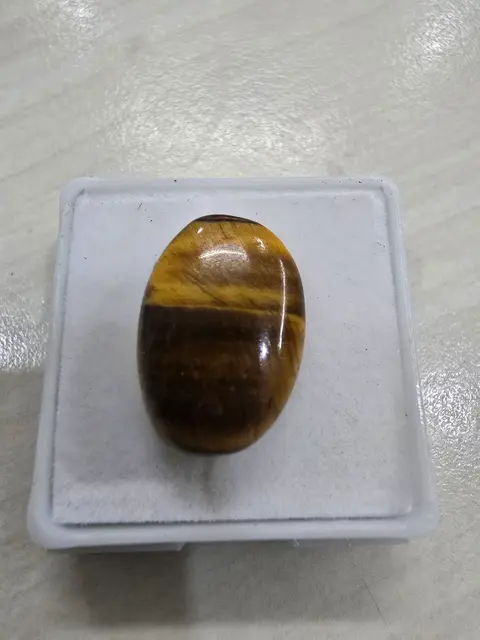
Tiger's eye: Tiger eye stone
Tiger eye stone. Photo: Ikigai azma nasreen, CC0, via Wikimedia Commons.
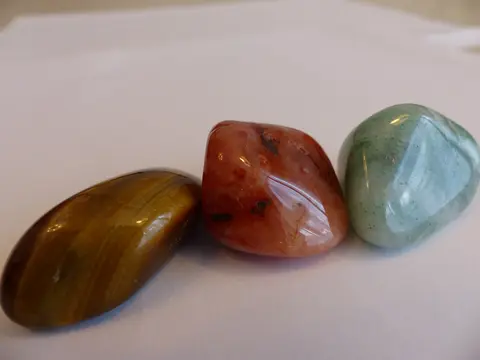
Tiger's eye: Tiger's eye 2
Tiger's eye 2. Photo: Simon A. Eugster, CC BY-SA 3.0, via Wikimedia Commons.
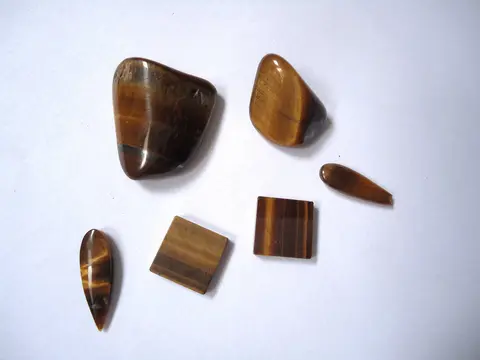
Tiger's eye: Tiger's eye gems
Tiger's eye gems. Photo: Mauro Cateb, CC BY-SA 3.0, via Wikimedia Commons.

What tiger's eye is worth

Dealer asking prices for tiger's eye, middle half of current listings, checked 2026-11-20. Bar shows the 25th to 75th percentile; the dark tick is the median.
Form and sizeTypical asking priceRange chartMedianListings
Slabs and polished pieces (per piece)$55 to $125$7216 from 1 dealer
10 to 20 cm (4 to 8 in)$55 to $75$659 from 1 dealer
Tumbled stones (per pound)$20 to $153$209 from 2 dealers
Spheres (per piece)$15 to $262$297 from 1 dealer
Rough (per pound)$7.32 to $9.16$7.797 from 1 dealer
Carvings and shapes (per piece)Not enough data (4 listings, need 5)
Show 12 of the listings behind these numbers
Sample dealer listings for Tiger's eye
ListingSizeLocalityAskingSeen
1.5" Red Tiger's Eye Worry Stones
FossilEra
3.8 cm$4
Blue Tiger's Eye Worry Stone - 1.5" Size
FossilEra
3.8 cm$4
.9" Polished Tiger's Eye Sphere
FossilEra
$4
.9" Polished Blue Tiger's Eye Sphere
FossilEra
$4
1.1" Polished Tiger's Eye Heart
FossilEra
2.8 cm$5
1.7" Polished Blue Tiger's Eye Pocket Stone
FossilEra
4.3 cm$6
Brown Tiger Eye - Small
Kingsley North
1 lb$6
TIGERS EYE Tumbled Stones - Tumbled Crystals, Self Care, Healing Crystals and Stones, E0437
Throwin Stones
3.8 cm$6.30
RED TIGERS EYE Tumbled Stones - Tumbled Crystals, Self Care, Healing Crystals and Stones, E1520
Throwin Stones
2.5 cm$6.75
1.8" Polished Red Tiger's Eye Worry Stone
FossilEra
4.6 cm$7
1.7" Polished Red Tiger's Eye Pocket Stone
FossilEra
4.3 cm$7
1.7" Polished Tiger's Eye Pocket Stone
FossilEra
4.3 cm$7

These are dealer asking prices: what shops list tiger's eye for, not what it sells for and not an appraisal. Selling to a dealer usually brings well below retail, because the dealer has to resell it at a margin.

How to identify tiger's eye

Tiger's eye is quartz intergrown with fine parallel fibers of the blue amphibole riebeckite (crocidolite), whose iron has oxidized to golden brown. The fibers give polished stones a rolling band of silky light called chatoyancy.

  • Bands of golden to brown silky light that roll across the surface when the stone is tilted.
  • Parallel fibrous structure visible on broken or unpolished surfaces.
  • Alternating golden, brown and sometimes blue bands that follow the fiber direction.
  • Hardness about 7: scratches glass.
  • Opaque, with a silky polish and SG about 2.6 to 2.7.
  • Cool to the touch and heavier than plastic or resin beads.

Tiger's eye varieties

Golden tiger's eye

Golden tiger's eye is the classic yellow to golden brown tiger's eye, colored by iron oxides from oxidized riebeckite fibers. It is the standard form of tiger's eye; most material sold simply as tiger's eye is golden.

Where tiger's eye comes from

Griqualand West, Northern Cape, South Africa
The main world source, from banded ironstone around Prieska and Griquatown, producing golden and blue material.
Hamersley Range, Western Australia
Tiger iron and marra mamba tiger's eye, layered with hematite and jasper.
Namibia
Tiger's eye and the brecciated relative pietersite.
India, China and Myanmar
Smaller production, mostly for beads.

Tiger's eye lookalikes

Tiger iron

Tiger iron has layers of metallic silver hematite and red jasper between the tiger's eye bands.

  • Heavier overall from hematite
  • Hematite layers leave a red-brown streak

tigers eye vs tiger iron

Pietersite

Pietersite shows swirled, broken fiber patches in many directions rather than straight parallel bands.

  • Same materials, brecciated and recemented
  • Blue, gold and red swirls

pietersite vs tigers eye

Cat's eye chrysoberyl

Chrysoberyl shows one sharp eye line on a transparent to translucent honey body and is much heavier.

  • SG about 3.73
  • Hardness 8.5

Gold sheen obsidian

Obsidian is black glass with a sheen beneath the surface and no fibrous banding.

  • Hardness 5 to 5.5
  • Conchoidal fracture

Also mistaken for tiger's eye: chrysotile, jasper, bumblebee jasper, yellow jasper, binghamite, bronzite.

Fake, dyed and treated tiger's eye

  • Fiber optic cat's eye glass beads

    Very common

    • Too perfectly even sheen with no color banding
    • Honeycomb hexagonal pattern visible on the ends under a loupe
    • Bright unnatural colors
  • Dyed tiger's eye in green, pink, purple or bright blue

    Common

    • Colors that do not occur naturally
    • Dye concentrated in cracks and drill holes
    • Color on an acetone swab
  • Heated red tiger's eye sold as natural

    Very common

    • Red to mahogany color across the stone
    • Natural red is uncommon
    • Cannot be confirmed at home
  • Resin or plastic tiger's eye imitation

    Occasional

    • Warm, light feel
    • Printed or molded pattern without true chatoyancy
    • Scratched by a steel needle

Is my tiger's eye real? Tests you can do at home

  1. Rolling light test

    Hold the stone under one light and slowly tilt it.

    Real
    Bright bands move and flip from light to dark as you tilt.
    Fake or lookalike
    Printed or molded imitations show a fixed pattern.
  2. Loupe on the ends

    Use a 10x loupe on a bead's drill hole or an end of the stone.

    Real
    Irregular wavy fibers in quartz.
    Fake or lookalike
    Fiber optic glass shows a regular honeycomb grid.
  3. Acetone swab for dye

    Rub an acetone soaked swab around a drill hole or hidden spot.

    Real
    Swab stays clean.
    Fake or lookalike
    Dyed beads leave color on the swab.
  4. Scratch against glass

    Press a sharp edge of rough or a bead against a glass bottle.

    Real
    Scratches glass.
    Fake or lookalike
    Plastic does not; glass skids.

    Can leave a small mark.

A stone that passes these tests is consistent with natural tiger's eye, not proven. For valuable pieces, a gem lab report settles treatment and origin.

Treatments

Heating (common)
Turns golden stones red or mahogany by oxidizing iron; widely accepted for low cost material. Not reliably detectable at home.
Dyeing (common)
Creates unnatural colors; lowers value to decor level. Acetone swab and unnatural color.
Bleaching (occasional)
Lightens stones to honey tones. Lab only.

What moves the price of tiger's eye

  1. Chatoyancy. Sharp, bright, rolling bands across the whole stone.
  2. Color. Rich golden or deep blue with even banding.
  3. Cut. Domes oriented so fibers run parallel to the base give the best shimmer.
  4. Treatment. Natural color is worth more than dyed.
  5. Size and craftsmanship. Large carvings and spheres need big, clean pieces.

Questions collectors ask about tiger's eye

How rare is a tiger eye?
Tiger's eye is common; South Africa produces large amounts. Well-banded pieces with strong chatoyancy and natural color are the better grades.
How to tell if a tiger eye stone is real?
Real tiger's eye has irregular golden bands that roll and flash as you tilt it, scratches glass, and shows wavy fibers under a loupe. Fiber optic glass has an even sheen and a honeycomb pattern at the ends.
Is tiger eye worth anything?
Most tiger's eye is inexpensive. Value rises for strong chatoyancy, even color, large carvings and good jewelry settings; see the price table above.
Petrified wood vs tiger's eye: how do you tell them apart?
Petrified wood shows growth rings and wood grain and its sheen stays still when tilted. Tiger's eye has straight parallel fibers whose bands of light roll as you move the stone.

Sources

Prices: 64 current listings from FossilEra, Kingsley North, Throwin Stones, seen 2026-11-20 to 2026-11-20. How we collect prices.