What pietersite is worth
Show 12 of the listings behind these numbers
These are dealer asking prices: what shops list pietersite for, not what it sells for and not an appraisal. Selling to a dealer usually brings well below retail, because the dealer has to resell it at a margin.
How to identify pietersite
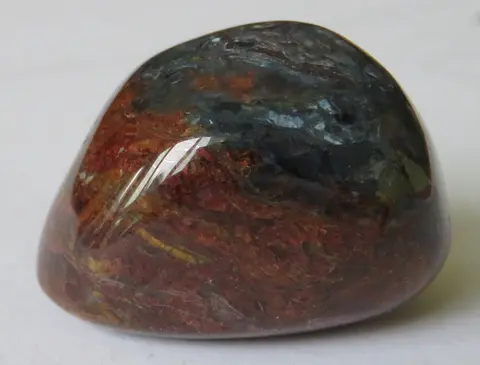
Pietersite is a brecciated rock of broken tiger's eye and hawk's eye: fibrous riebeckite (crocidolite) that has been replaced or cemented by quartz and chalcedony, then fractured and re-cemented. It is a trade name rather than a mineral species, named for Sid Pieters, who described the Namibian material in 1962.
- Swirling, chaotic chatoyancy: patches of silky light that move in different directions as the stone is turned, rather than parallel bands.
- Mixed blue-gray, gold-brown and red-brown colors in angular to stretched fragments.
- Hardness about 7: scratches glass easily.
- SG about 2.6 to 2.8, similar to quartz.
- Sold almost only as polished cabochons, beads and slabs; rough looks dull and fibrous.
Where pietersite comes from
- Namibia
- Original source, described by Sid Pieters in 1962; Namibian material is the reference standard and supply is limited.
- China
- Chinese material, sometimes sold as Chinese pietersite, usually with more red-brown and less blue.
Pietersite lookalikes
Tiger's eye shows straight parallel bands of chatoyancy; pietersite shows swirling patches pointing in many directions.
- Same hardness and SG
- Tiger's eye is not brecciated
pietersite vs tigers eye
Hawk's eye is evenly blue with straight bands; pietersite mixes blue with gold and red in chaotic patterns.
Red tiger's eye is heated tiger's eye with straight bands.
Also mistaken for pietersite: binghamite.
Fake, dyed and treated pietersite
Ordinary or mixed tiger's eye sold as pietersite
Common
- Straight, parallel chatoyant bands
- No brecciated fragments
Dyed tiger's eye or dyed brecciated stone
Occasional
- Unnatural blue or purple tones
- Dye concentrated in cracks
- Color on an acetone swab
Chinese material sold as Namibian pietersite
Occasional
- Origin cannot be proven by home tests; rely on the seller's documentation
Is my pietersite real? Tests you can do at home
-
Chatoyancy direction check
Rotate the polished stone slowly under a single light source such as a phone flashlight.
- Real
- Silky flashes appear and vanish in different patches and directions.
- Fake or lookalike
- Tiger's eye shows straight bands that roll together across the stone.
-
Scratch test against glass
Press an edge of the stone across a glass bottle.
- Real
- Scratches glass easily.
- Fake or lookalike
- Glass and resin imitations do not.
Can leave a small mark.
-
Acetone swab for dye
Rub a hidden spot or drill hole with an acetone-soaked swab.
- Real
- Swab stays clean.
- Fake or lookalike
- Dyed material may leave color.
A stone that passes these tests is consistent with natural pietersite, not proven. For valuable pieces, a gem lab report settles treatment and origin.
Treatments
- Stabilization (occasional)
- Resin may be used to hold together cracked brecciated pieces; slightly lowers value. Plastic luster in cracks; lab infrared testing.
- Heating (occasional)
- Can turn golden tones redder, as with red tiger's eye. Usually not detectable at home.
- Dyeing (occasional)
- Adds blue or other colors to low-grade material; lowers value. Acetone swab and dye in cracks.
What moves the price of pietersite
- Strength of chatoyancy. Bright, sharp flashes across most of the stone.
- Color. Strong blue and gold mixes rank above mostly brown or dull stones.
- Origin. Documented Namibian material is valued above Chinese.
- Soundness. Pieces without open cracks or heavy stabilization.
- Size and cut. Larger cabochons oriented to show the most flash.
Care and safety
The fibers are riebeckite (crocidolite) replaced or encased by quartz. Finished stones are safe to handle, but lapidaries should cut and grind it wet and avoid breathing dust.
Sources
Prices: 26 current listings from FossilEra, Throwin Stones, seen 2026-11-20 to 2026-11-20. How we collect prices.