Petrified wood vs tiger's eye
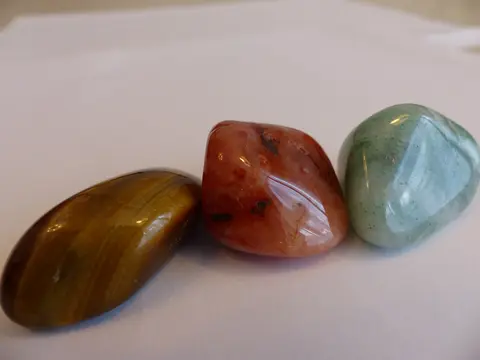
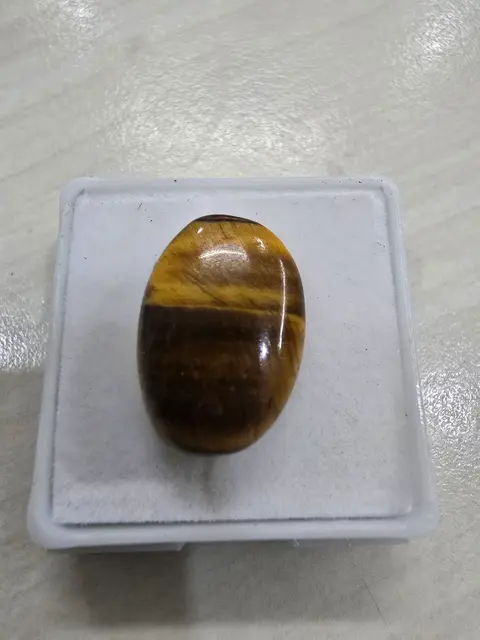
Tiger's eye shows a moving, silky chatoyant band of light from parallel fibers; wood shows grain and rings without that rolling glow.
Side by side
| Property | Petrified wood | Tiger's eye |
|---|---|---|
| Hardness (Mohs) | 6.5 to 7 for quartz-replaced wood; about 5.5 to 6 for opalized wood | 6.5 to 7 |
| Specific gravity | About 2.6 for quartz-replaced wood; lower (about 2.0 to 2.2) for opalized wood | 2.64 to 2.71 |
| Luster | Waxy to vitreous when polished, dull when rough | Silky to vitreous when polished |
| Streak | White | |
| Crystal system | Trigonal (quartz) | |
| Cleavage | None | |
| Refractive index | About 1.54 (spot reading) | |
| Formula | Mostly SiO2 (chalcedony, quartz or opal), with iron oxides and other trace minerals | SiO2 with included riebeckite fibers |
| Typical dealer asking price | $99 to $293 (slabs and polished pieces) | $55 to $125 (slabs and polished pieces) |
How to tell them apart
- Tiger's eye is quartz replacing crocidolite fibers
- Golden to brown with a strong sheen
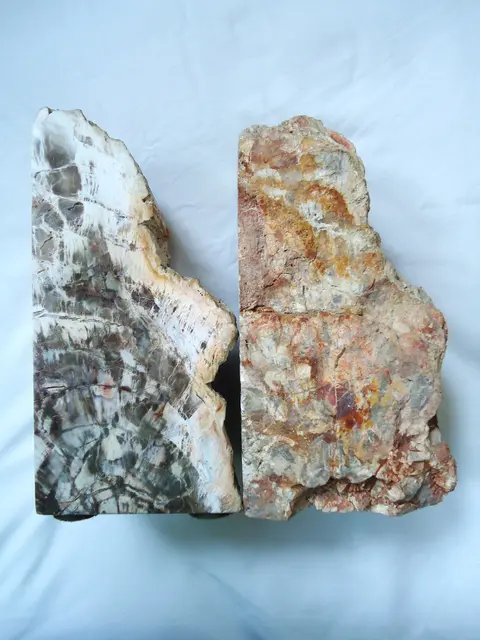
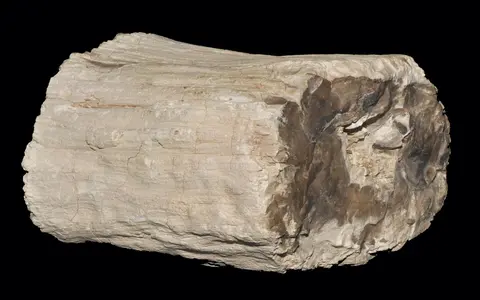
Petrified wood shows growth rings and cell texture, and its sheen does not roll when tilted.
- Hardness 7
- Grain matches tree structure
Photos of each
Petrified wood


Tiger's eye


More on each: petrified wood value and identification and tiger's eye value and identification.