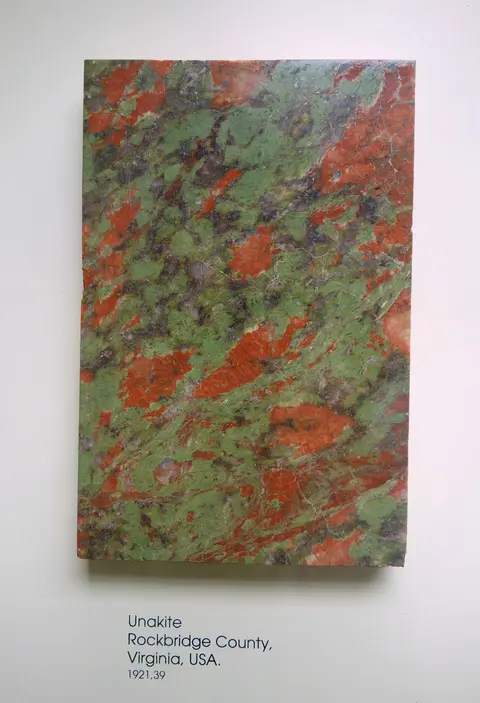
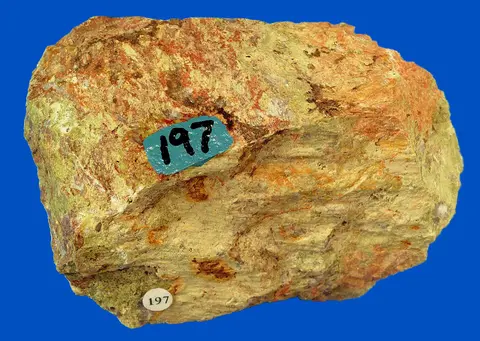
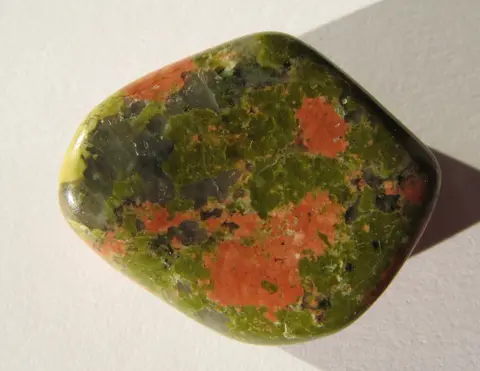
Unakite is an altered granite made of pink orthoclase feldspar, green epidote and clear to milky quartz. The epidote formed when hydrothermal fluids altered the original rock, giving the typical salmon pink and pistachio green mottling.
Prices checked . Page updated .
Unakite, Rockbridge County, Virginia, USA - Natural History Museum, London - DSC05286. Photo: Daderot, CC0, via Wikimedia Commons.
Unakite (GeoDIL number - 435). Photo: Nessa Eull, CC0, via Wikimedia Commons.
Unakit - tumble polished stone. Photo: Ra'ike (see also: de:Benutzer:Ra'ike ), CC BY 3.0, via Wikimedia Commons.
What unakite is worth
Not enough data. We have not yet seen 5 or more current dealer listings for unakite in any one form, so we show no range rather than guess.
These are dealer asking prices: what shops list unakite for, not what it sells for and not an appraisal. Selling to a dealer usually brings well below retail, because the dealer has to resell it at a margin.
How to identify unakite
Mottled pink and olive to pistachio green patches, with grayish or clear quartz grains between them
Granular texture: individual mineral grains are visible to the eye or with a loupe
Pink areas show flat cleavage flashes when the rock is turned in light (feldspar)
Takes a good polish, but the polish can look slightly uneven across the different minerals
Scratches glass easily
Feels about as heavy as granite, slightly heavier than quartz
Where unakite comes from
Unaka Mountains, North Carolina and Tennessee, USA
Type area that gave the rock its name.
Blue Ridge, Virginia, USA
Unakite occurs in place and as river and beach pebbles in parts of Virginia.
South Africa
Commercial source for tumbled stones, beads and carvings.
China
Large volume of bead and tumbled material in the bead trade.
Lake Superior region, USA
Unakite pebbles carried by glaciers turn up on Great Lakes beaches and gravels.
Unakite sold as "unakite jasper" or "epidote jasper"
Common
Same rock under a trade name: it is altered granite, not jasper
Dyed pale granite or quartzite sold as unakite
Rare
Color concentrated along cracks and grain boundaries
Acetone swab picks up color
Green is too even or too bright
Glass or resin beads printed or mottled to imitate unakite
Rare
No grain texture under a loupe
Bubbles in the material
Lighter in hand for resin
Is my unakite real? Tests you can do at home
Loupe on the texture
Look at a polished or broken surface with a 10x loupe.
Real
Distinct interlocking grains of pink feldspar, green epidote and glassy quartz.
Fake or lookalike
Glass and resin show swirls or bubbles; jasper shows a smooth, fine texture.
Scratch test against glass
Press a sharp edge of the stone against a glass bottle or tile and drag.
Real
Scratches glass (hardness 6 to 7).
Fake or lookalike
Resin does not scratch glass and gets marked itself.
Can leave a small mark.
Acetone swab
Rub an inconspicuous spot with a cotton swab dipped in acetone (nail polish remover).
Real
Swab stays clean.
Fake or lookalike
Dyed stones leave pink or green on the swab.
A stone that passes these tests is consistent with natural unakite, not proven. For valuable pieces, a gem lab report settles treatment and origin.
Treatments
Waxing or oiling of polished pieces (occasional)
Improves surface shine on beads and tumbled stones; little effect on value for a low-cost rock. Greasy feel or a dulled finish after cleaning with warm soapy water.
What moves the price of unakite
Color contrast. Strong salmon pink and bright green with even distribution is preferred over washed out or mostly green material.
Finish and workmanship. Carvings, spheres and well-polished slabs bring more than tumbled stones or rough.
Size. Large, crack-free pieces for spheres and carvings are less common than small tumbles.
Fractures. Open cracks and pitted polish reduce value.
Sources
Prices: 11 current listings from FossilEra, Kingsley North, The Gem Shop, Throwin Stones, seen 2026-11-20 to 2026-11-20. How we collect prices.