Dealer asking prices for zoisite, middle half of current listings, checked 2026-11-20. Bar shows the 25th to 75th percentile; the dark tick is the median.
These are dealer asking prices: what shops list zoisite for, not what it sells for and not an appraisal. Selling to a dealer usually brings well below retail, because the dealer has to resell it at a margin.
How to identify zoisite
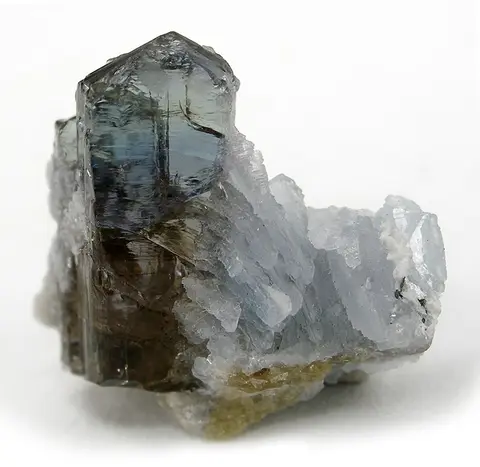
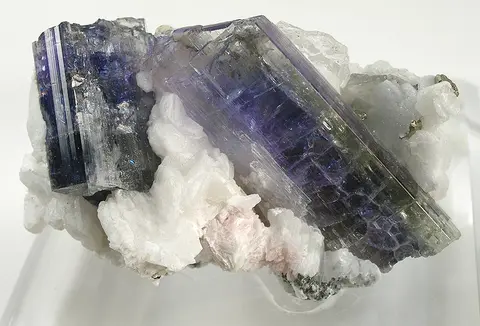
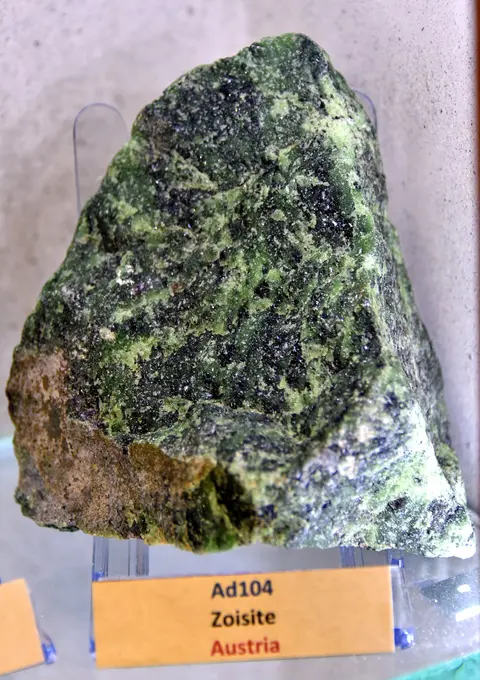
Zoisite is a calcium aluminum silicate of the epidote group that forms in metamorphic rocks. It occurs as green massive rock, pink thulite, and as the transparent blue to violet gem tanzanite.
Crystals are striated prisms with one perfect cleavage, often showing flat, pearly cleavage faces
Transparent crystals are strongly pleochroic: the color changes noticeably as you rotate the stone (blue, violet and brownish yellow in tanzanite)
Hardness 6 to 7: scratches glass with effort, softer than quartz
Fairly heavy for a silicate, SG about 3.2 to 3.4, so it feels heavier than quartz of the same size
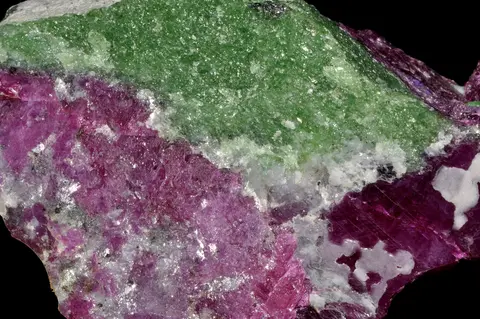
Massive green zoisite often hosts red ruby crystals and black hornblende
Pink massive zoisite (thulite) is often mottled with white quartz or calcite
Green zoisite is green massive or transparent zoisite; massive green material is the host rock of ruby in zoisite, and transparent green crystals come from the tanzanite mines. Massive green zoisite is an ornamental rock, while transparent green zoisite is a scarce gem that is usually not heated.
Where zoisite comes from
Merelani Hills, Manyara Region, Tanzania
The only commercial source of tanzanite, discovered in 1967; also produces gem green and pink zoisite.
Longido, Tanzania
Source of ruby in zoisite (anyolite), green zoisite rock with ruby crystals.
Telemark, Norway
Classic source of pink thulite.
Saualpe, Carinthia, Austria
Type locality of zoisite, named after the mineral collector Sigmund Zois.
Rhodonite usually has black manganese oxide veins and is heavier (SG 3.4 to 3.7).
Rhodonite has two good cleavages at nearly right angles
Fake, dyed and treated zoisite
Synthetic forsterite sold as tanzanite
Common
Strong doubling of back facet edges under a loupe (birefringence about 0.035)
Less pleochroism than tanzanite
Often sold online at very low prices without a lab report
Violet blue glass and cubic zirconia
Common
No color change when rotated
Glass shows bubbles and soft, rounded facet edges
Cubic zirconia shows strong rainbow fire
Cobalt coated pale zoisite or other stones
Occasional
Coating worn at facet edges
Color concentrated on the surface
Disclosed by labs as coated
Dyed rock sold as ruby in zoisite
Rare
Red patches with no crystal form
Color in cracks
Is my zoisite real? Tests you can do at home
Pleochroism check
Look at a transparent stone from the top, then turn it and look through from the side under white light.
Real
Tanzanite shifts between blue and violet, and untreated or some stones show a brownish or yellowish direction.
Fake or lookalike
Glass and cubic zirconia stay the same color from every angle.
Loupe check for doubling
Look through the table at the back facet edges with a 10x loupe.
Real
Tanzanite shows single, crisp edges.
Fake or lookalike
Synthetic forsterite shows clearly doubled edges.
Weight in hand
Compare the stone with a quartz or glass piece of similar size, or measure specific gravity with a kitchen scale and water.
Real
SG about 3.3 to 3.4.
Fake or lookalike
Glass is usually lighter (2.4 to 2.6); cubic zirconia is much heavier (5.6 to 6.0).
UV for ruby in zoisite
Shine a longwave UV torch on ruby in zoisite in the dark.
Real
Ruby crystals glow red.
Fake or lookalike
Dyed or painted spots stay dark or glow oddly.
A stone that passes these tests is consistent with natural zoisite, not proven. For valuable pieces, a gem lab report settles treatment and origin.
Treatments
Heating (tanzanite) (almost always)
Removes the brownish yellow component and leaves pure blue to violet. Accepted throughout the trade and priced as standard. Not detectable by standard lab tests in most cases; assume tanzanite is heated.
Coating (rare)
Adds color to pale stones; coated stones have far lower value and the coating wears. Wear at facet edges; lab confirmation.
Stabilizing of massive material (occasional)
Resin can be used in porous ruby in zoisite or thulite carvings. Resin sheen in cracks under a loupe.
What moves the price of zoisite
Variety. Tanzanite is the gem variety; ruby in zoisite and thulite are ornamental stones sold by size and pattern.
Color saturation. For tanzanite, deep saturated violet blue is the top grade, while pale lavender is far lower.
Size. Saturated color is easier to achieve in larger tanzanites, so price per carat rises with size.
Clarity. Tanzanite trades as an eye clean gem; visible inclusions drop value sharply.
Cut. Well proportioned cuts that show both blue and violet are preferred.
Pattern (ornamental types). Ruby in zoisite with large, well colored ruby crystals and contrasting green matrix sells best.
Care and safety
Zoisite has perfect cleavage and moderate hardness. Avoid ultrasonic and steam cleaners, sudden temperature changes and hard knocks; tanzanite rings worn daily can chip.
Questions collectors ask about zoisite
Where is tanzanite mined?
Tanzanite is mined only in the Merelani Hills near Arusha in northern Tanzania, a small area a few kilometers long. That single source is part of why it is considered rare.
Is tanzanite a birthstone?
Yes. Tanzanite was added as a December birthstone in 2002, alongside turquoise and zircon.
Sources
Prices: 23 current listings from FossilEra, iRocks (The Arkenstone), Kingsley North, Throwin Stones, seen 2026-11-20 to 2026-11-20. How we collect prices.