What sulfur is worth
Show 12 of the listings behind these numbers
These are dealer asking prices: what shops list sulfur for, not what it sells for and not an appraisal. Selling to a dealer usually brings well below retail, because the dealer has to resell it at a margin.
How to identify sulfur
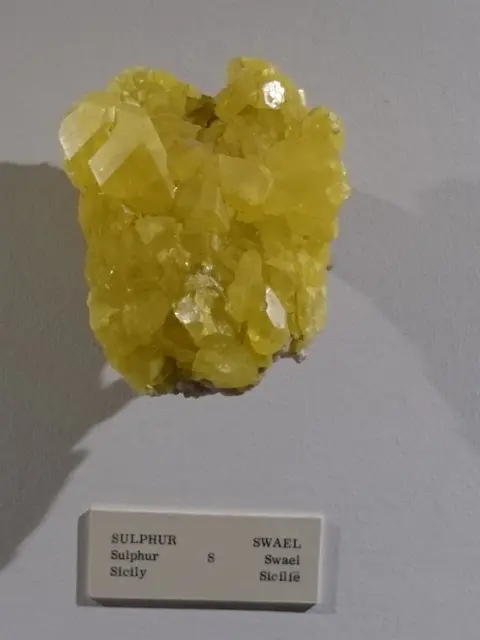
Native sulfur is the element sulfur (S) occurring as bright yellow crystals and crusts, formed around volcanic vents and by bacterial reduction of gypsum and anhydrite in sedimentary rocks. Collectors prize the sharp, translucent crystals from Sicily and Poland.
- Bright lemon yellow to amber yellow color with a resinous to greasy luster.
- Very light in hand: specific gravity about 2.07, lighter than quartz.
- Soft: a fingernail can just scratch it (hardness 1.5 to 2.5) and it is brittle.
- Crystals are pointed double pyramids (dipyramids) or thick tabular forms.
- Pale yellow to white streak.
- Volcanic sulfur forms crusty, powdery or needle-like coatings around vents.
Sulfur varieties
Sicilian sulfur
Native sulfur from the historic sedimentary mines of central and southern Sicily, the classic source of large, sharp, translucent sulfur crystals. Sicilian sulfur is defined by locality and quality: crystals are larger and clearer than most sulfur and often sit with celestine, aragonite or calcite.
Where sulfur comes from
- Agrigento and Caltanissetta provinces, Sicily, Italy
- The classic source of large, sharp, translucent sulfur crystals, often with celestine, aragonite or calcite, from mines now closed.
- Tarnobrzeg and Machów, Poland
- Sedimentary sulfur deposits that produced well-formed crystals.
- Kawah Ijen, East Java, Indonesia
- Active volcanic vents where sulfur is still mined by hand; source of many volcanic sulfur pieces.
- Vulcano, Aeolian Islands, Italy
- Fumarole sulfur crusts and needle crystals.
- Gulf Coast salt domes, Texas and Louisiana, USA
- Major industrial sulfur source historically, extracted underground by the Frasch hot water process.
Sulfur lookalikes
Orpiment has perfect cleavage into flexible pearly flakes and an orange-yellow color; sulfur is brittle and does not flake.
- Orpiment is an arsenic sulfide and toxic
- Specific gravity about 3.5
- Pearly to resinous luster
Calcite cleaves into rhombs and is heavier; sulfur breaks irregularly.
- Calcite hardness 3
- Specific gravity 2.71
- Calcite reacts slowly with vinegar when powdered
Barite is very heavy for a light-colored mineral (specific gravity 4.5).
- Hardness 3 to 3.5
- Tabular crystals with good cleavage
Fluorite forms cubes, cleaves into octahedra and is harder (4).
Also mistaken for sulfur: sphalerite, carnotite, legrandite.
Fake, dyed and treated sulfur
Remelted or recrystallized sulfur sold as natural crystals
Occasional
- Needle-like or feathery crystals in a uniform mass with no matrix
- Flat bottom from a container
- Smooth melted surfaces
Yellow glass or resin sold as sulfur
Rare
- Not soft enough to scratch with a fingernail
- No sulfur smell when rubbed briskly
- Glass feels cold and heavier
Is my sulfur real? Tests you can do at home
-
Fingernail and weight
Lift the piece to judge its weight, then press a fingernail on an unseen spot.
- Real
- Feels very light for its size and may take a faint fingernail mark.
- Fake or lookalike
- Calcite and fluorite are not marked by a fingernail; barite feels heavy.
Can leave a small mark.
-
Streak plate
Rub a small corner on unglazed ceramic.
- Real
- Pale yellow to white streak.
- Fake or lookalike
- Orpiment gives a yellow streak but flakes easily into pearly sheets.
Can leave a small mark.
-
Specific gravity with a kitchen scale
Weigh dry, then weigh the water displaced when suspended in a cup on the scale; divide. Use room temperature water.
- Real
- About 2.07.
- Fake or lookalike
- Calcite 2.71, fluorite 3.18, barite 4.5.
-
Faint odor when rubbed
Rub a small area briskly with a dry cloth and sniff from a normal distance.
- Real
- A faint sulfur smell may be noticeable.
- Fake or lookalike
- Glass, resin and calcite have no smell.
A stone that passes these tests is consistent with natural sulfur, not proven. For valuable pieces, a gem lab report settles treatment and origin.
Treatments
- Lacquer or clear coating (occasional)
- Sometimes applied to slow surface dulling; reduces value for collectors if heavy. Glossy film and unnatural uniform shine under a loupe.
What moves the price of sulfur
- Crystal quality. Sharp, glassy, translucent crystals with undamaged points are worth far more than massive or crusty sulfur.
- Locality. Classic Sicilian specimens from closed mines carry the strongest premium.
- Associations. Sulfur with white celestine, aragonite or calcite makes the most attractive specimens.
- Size. Large single crystals are scarce and fragile.
- Damage. Sulfur cracks and chips easily; thermal cracks and broken tips reduce value.
Care and safety
Solid sulfur has low toxicity, but it is flammable and melts at low temperature; burning sulfur gives off sulfur dioxide, a toxic gas. Wash hands after handling powdery pieces.
Sulfur cracks from sudden temperature changes, including the warmth of a hand or a strong lamp. Let specimens adjust to room temperature slowly, keep them away from heat and sunlight, and never wash them in hot water.
Questions collectors ask about sulfur
- Does pure sulfur smell?
- Pure solid sulfur has little or no smell at room temperature. The rotten egg smell people associate with sulfur comes from hydrogen sulfide gas, and burning sulfur smells sharp from sulfur dioxide.
- Is pure sulfur dangerous?
- Solid sulfur is low in toxicity and safe to handle with normal care, though dust can irritate eyes and lungs. It is flammable, and burning it releases toxic sulfur dioxide gas.
- What are 10 uses of sulphur?
- Most sulfur goes into sulfuric acid, which is used to make phosphate fertilizers, refine metals and run industrial processes. Other uses include rubber vulcanization, fungicides, matches, gunpowder, pharmaceuticals, paper pulping, batteries and soil conditioning.
- Is sulfur valuable?
- Industrial sulfur is a bulk commodity recovered mainly from oil and gas refining. Specimen value is different: sharp, translucent crystals from classic localities such as Sicily are collected and priced on crystal quality; see the price table above.
Sources
Prices: 12 current listings from FossilEra, The Gem Shop, seen 2026-11-20 to 2026-11-20. How we collect prices.