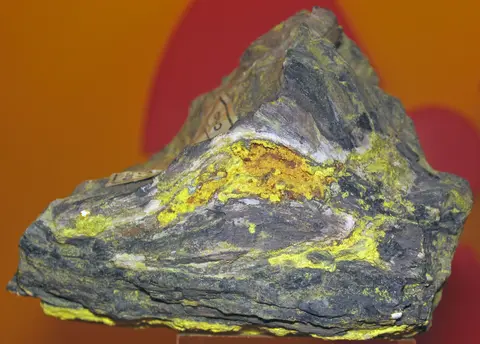
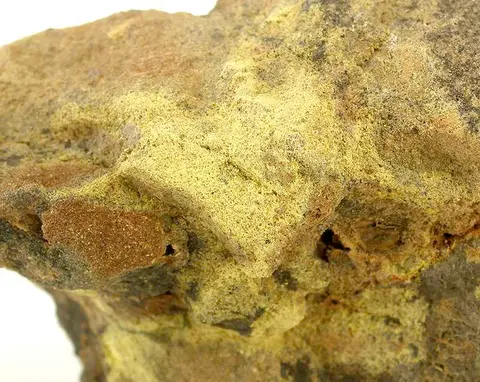
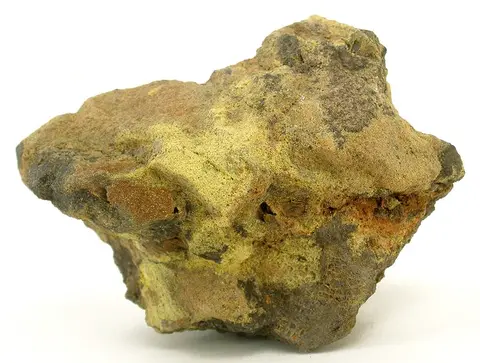
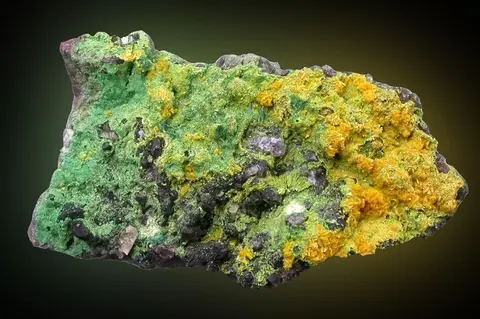
Carnotite is a hydrated potassium uranyl vanadate, a bright canary yellow uranium mineral that coats sandstone, fossil wood and bone. It was a major ore of uranium and vanadium on the Colorado Plateau and is strongly radioactive.
Not enough data. We have not yet seen 5 or more current dealer listings for carnotite in any one form, so we show no range rather than guess.
These are dealer asking prices: what shops list carnotite for, not what it sells for and not an appraisal. Selling to a dealer usually brings well below retail, because the dealer has to resell it at a margin.
How to identify carnotite
Bright canary yellow to greenish yellow powdery or earthy crusts and stains.
Usually coats or fills sandstone, petrified wood, fossil bone and other organic debris.
Very soft and crumbly (about 2); smears like chalk.
Does not glow, or glows only very weakly, under UV light, unlike many other yellow uranium minerals.
Reads strongly on a Geiger counter.
Visible crystals are very rare; when present they are tiny plates.
Where carnotite comes from
Uravan Mineral Belt, Colorado and Utah, USA
Classic source in Montrose and San Miguel counties, Colorado, and adjoining Utah; mined for radium, vanadium and uranium.
Paradox Valley, Colorado, USA
Type area; carnotite from Roc Creek was described in 1899 and named for French chemist Adolphe Carnot.
Grand and Emery counties, Utah, USA
Temple Mountain and other San Rafael Swell mines produced carnotite in fossil wood and sandstone.
Monument Valley, Arizona, USA
Carnotite ore in channels of the Shinarump sandstone.
Yeelirrie, Western Australia
Large calcrete-hosted carnotite deposit.
Carnotite lookalikes
Tyuyamunite
Tyuyamunite is the calcium analog and cannot be separated from carnotite without lab analysis.
Orpiment is orange-yellow with resinous to pearly, flexible flakes and is not radioactive.
Arsenic sulfide, toxic
SG about 3.5
Yellow ochre (limonite)
Ochre is duller yellow-brown, gives a yellow-brown streak and is not radioactive.
Very common iron stain
No Geiger response
Fake, dyed and treated carnotite
Yellow painted or stained rock sold as uranium ore
Rare
No reading on a Geiger counter
Paint sits on the surface rather than soaking into grains
Glossy or plastic-like coating
Other yellow secondary minerals labeled carnotite
Occasional
Strong UV fluorescence suggests autunite, uranophane or another phosphate or silicate
Crystalline crusts rather than earthy coatings
Is my carnotite real? Tests you can do at home
Geiger counter
Hold a Geiger counter or radiation detector near the specimen, without touching it.
Real
Strong reading well above background.
Fake or lookalike
Sulfur, ochre and painted rocks read at background.
Longwave UV torch
In a dark room, shine a 365 nm UV light on the yellow areas.
Real
Little or no glow.
Fake or lookalike
Autunite and many other uranium minerals glow bright yellow-green.
Visual habit check
Look at the yellow with a loupe from a short distance without handling it.
Real
Earthy, powdery yellow soaking into sandstone grains or wood structure.
Fake or lookalike
Paint forms a film; sulfur shows glassy crystals.
A stone that passes these tests is consistent with natural carnotite, not proven. For valuable pieces, a gem lab report settles treatment and origin.
Treatments
Sealing with lacquer or resin (occasional)
Reduces dusting of the powdery coating; collectors generally accept it for safety. Glossy film over the yellow areas.
What moves the price of carnotite
Specimen type. Carnotite replacing petrified wood or fossil bone is more sought after than stained sandstone.
Color intensity. Bright, unaltered canary yellow coatings are preferred over faded or patchy material.
Crystals. Visible crystals are rare and command a premium.
Locality and history. Specimens from named historic Colorado Plateau mines carry collector interest.
Condition. Powdery coatings rub off easily; intact, undusted specimens are worth more.
Care and safety
Carnotite is strongly radioactive and its powder can be inhaled or swallowed. Handle with gloves or tools, never grind, cut or crush it, wash hands after handling, keep it away from children and pets, and check local and carrier rules before shipping radioactive minerals.
Store in a sealed, labeled container away from living and sleeping areas, ideally in a ventilated space. Do not dust, brush or wash the specimen.