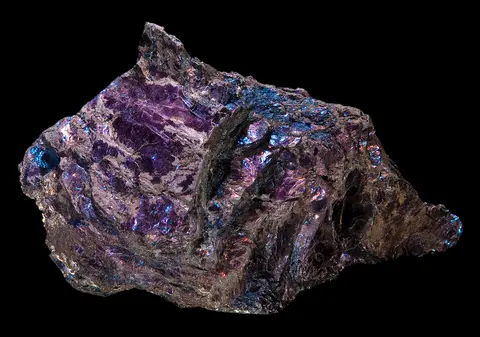
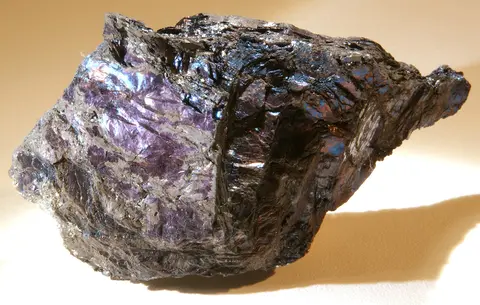
Covellite is copper sulfide (CuS), a soft secondary copper mineral known for its deep indigo blue color and purple, red and gold iridescence. It forms thin, flexible hexagonal plates and massive coatings in the upper, altered zones of copper deposits.
Prices checked . Page updated .
Covellite-USA. Photo: Didier Descouens, CC BY 3.0, via Wikimedia Commons.
Covellite. Photo: Didier Descouens, CC BY-SA 3.0, via Wikimedia Commons.
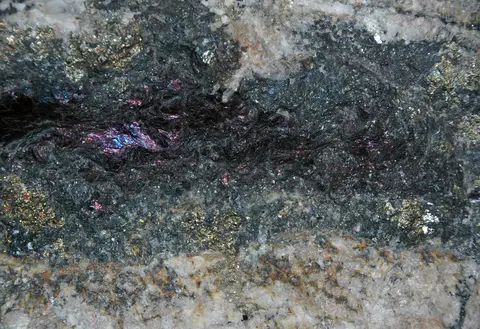
Covellite-enargite-pyrite hydrothermal vein in quartz monzonite (Butte Mining District, Montana, USA) 2. Photo: James St. John, CC BY 2.0, via Wikimedia Commons.
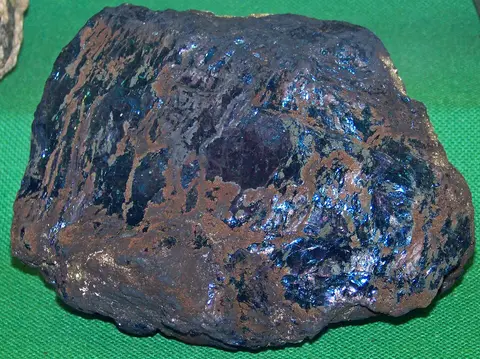
Covellite (latest Cretaceous to earliest Tertiary, 62-66 Ma; Butte Mining District, Montana, USA) 2. Photo: James St. John, CC BY 2.0, via Wikimedia Commons.
What covellite is worth
Not enough data. We have not yet seen 5 or more current dealer listings for covellite in any one form, so we show no range rather than guess.
These are dealer asking prices: what shops list covellite for, not what it sells for and not an appraisal. Selling to a dealer usually brings well below retail, because the dealer has to resell it at a margin.
How to identify covellite
Indigo to midnight blue with a metallic to submetallic sheen, often with purple, magenta, gold or green iridescence.
Thin hexagonal plates and platy masses that split into flexible sheets along one perfect cleavage.
Very soft (1.5 to 2): a fingernail can mark it and it smudges on the fingers.
Gray to black, shiny streak on porcelain.
Heavy for its size (SG about 4.6 to 4.8).
Often found with pyrite, chalcocite, chalcopyrite and enargite in copper ore.
Where covellite comes from
Butte, Montana, USA
The Leonard and other Butte mines produced the finest large hexagonal plates and rosettes, prized by collectors.
Mount Vesuvius, Italy
Type locality; named for Niccolo Covelli, who described it from the volcano's fumaroles in the 1830s.
Calabona mine, Sardinia, Italy
Historic source of well crystallized plates.
Bor, Serbia
Large copper deposit with massive and crystallized covellite.
Peru and Bolivia
Andean copper mines supply much of the iridescent massive covellite used for cabochons and specimens.
Compare with a stone of similar size such as quartz.
Real
Feels heavy.
Fake or lookalike
Dyed or coated light rocks feel light.
A stone that passes these tests is consistent with natural covellite, not proven. For valuable pieces, a gem lab report settles treatment and origin.
Treatments
Resin stabilization (common)
Makes massive covellite durable enough for cabochons and beads; specimens for collectors are expected untreated. Glossy resin in pores, unusual durability, lab testing.
Coating with lacquer (occasional)
Slows tarnish on specimens; can dull iridescence and lower collector value. Uniform plastic-like shine, especially in crevices.
What moves the price of covellite
Crystal form. Sharp hexagonal plates and rosettes, especially from Butte, command far more than massive material.
Iridescence. Strong purple, magenta and gold color play on fresh surfaces adds value.
Locality. Classic localities such as Butte and Sardinia carry collector premiums.
Size and condition. Covellite is soft and smears easily, so undamaged plates are scarce; scuffs and bent plates reduce value.
Associations. Contrasting pyrite or enargite crystals on the same specimen improve display appeal.
Treatment. Stabilized cabochon material is valued as jewelry rough, not as a mineral specimen.
Care and safety
Copper sulfide is low risk in normal handling, but wash hands after handling and avoid creating or breathing dust when cutting.
Covellite is very soft and tarnishes; handle specimens by the matrix, avoid rubbing the plates, and store in a dry closed box away from humidity. Do not wash with water or chemicals, which can dull the luster.