Black moonstone vs labradorite
Dark labradorite has broad vivid blue and green flashes; some black moonstone is in fact labradorite.
Side by side
| Property | Black moonstone | Labradorite |
|---|---|---|
| Hardness (Mohs) | 6 to 6.5 | 6 to 6.5 |
| Specific gravity | About 2.56 to 2.72 | 2.68 to 2.72 |
| Luster | Vitreous, pearly on cleavage | Vitreous, pearly on cleavage |
| Streak | White | White |
| Crystal system | Monoclinic (orthoclase, sanidine) or triclinic (microcline, plagioclase) | Triclinic |
| Cleavage | Perfect in one direction, good in a second, at or near 90 degrees | Perfect in one direction, good in a second, at or near 90 degrees |
| Refractive index | 1.518 to 1.526 (orthoclase moonstone); 1.559 to 1.572 (labradorite) | 1.559 to 1.568 |
| Formula | KAlSi3O8 (potassium feldspar); NaAlSi3O8 to CaAl2Si2O8 (plagioclase series) | (Ca,Na)(Al,Si)4O8, about 50 to 70 percent anorthite |
| Typical dealer asking price | Not enough data | $77 to $163 (carvings and shapes) |
How to tell them apart
- RI near 1.56
Photos of each
Black moonstone
Labradorite
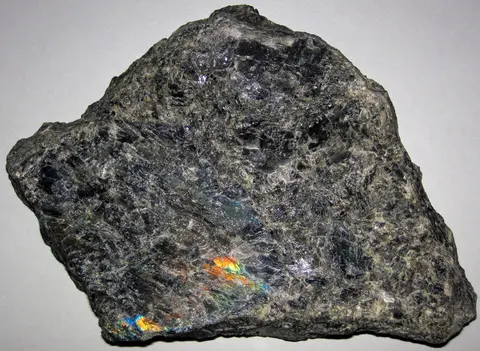

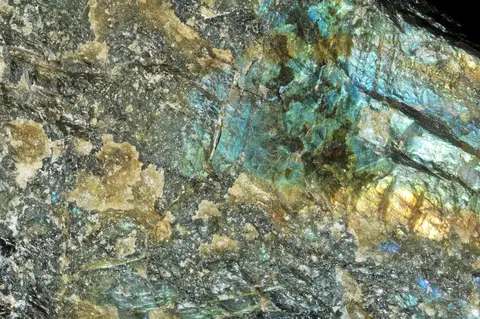

More on each: black moonstone value and identification and labradorite value and identification.