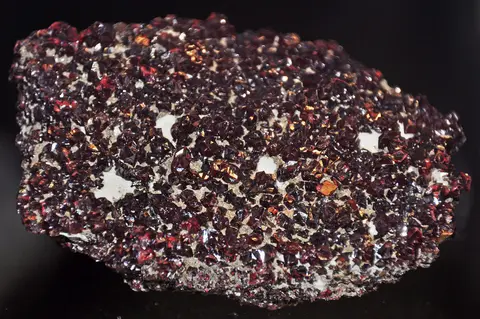
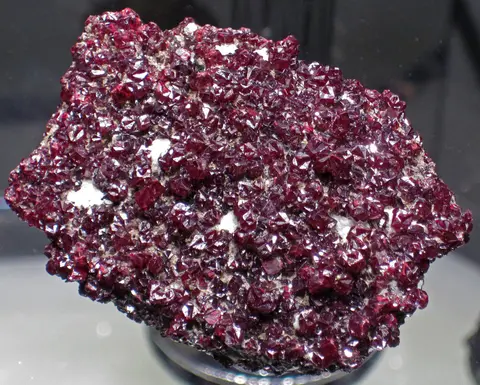
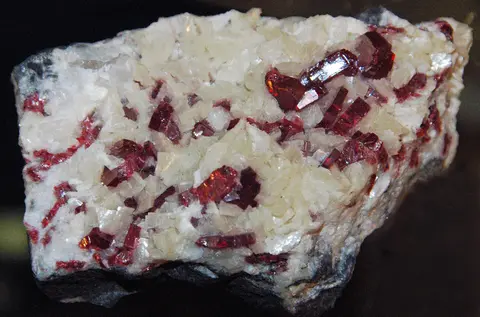
Cinnabar is mercury sulfide (HgS), the main ore of mercury, recognized by its bright scarlet to brick-red color and scarlet streak. It forms crusts, grains and, more rarely, sharp rhombohedral and twinned crystals.
Tongren Mine, Bijiang Dist., Tongren, Guizhou, China
$4,200
These are dealer asking prices: what shops list cinnabar for, not what it sells for and not an appraisal. Selling to a dealer usually brings well below retail, because the dealer has to resell it at a margin.
How to identify cinnabar
Bright scarlet to brick-red color; massive material can be brownish red.
Scarlet red streak, the single most useful field test.
Very heavy: SG about 8.1, heavier than galena.
Soft (2 to 2.5): scratched by a fingernail with effort and easily by a copper coin.
Adamantine luster on crystals, dull to earthy in massive ore.
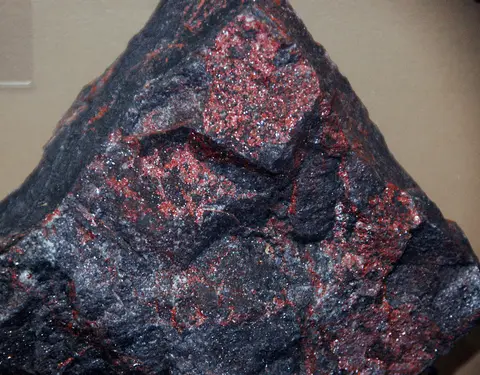
Usually as crusts and disseminated grains in quartz, opal, chalcedony, dolomite or sandstone near hot spring or volcanic activity.
Crystals are small rhombohedrons or thick tablets; penetration twins are prized.
Cinnabar varieties
Cinnabar in quartz
Cinnabar in quartz is milky or chalcedonic quartz with red cinnabar grains and veins, often from Chinese and western US deposits, cut into cabochons and tumbled stones. It is a rock pairing rather than a variety: the quartz host gives hardness for polishing, while the cinnabar supplies the red, and dyed imitations are common.
Where cinnabar comes from
Almaden, Ciudad Real, Spain
The largest mercury deposit in history, mined for more than two thousand years.
Hunan and Guizhou provinces, China
Source of the finest transparent cinnabar crystals and twins on white dolomite or quartz.
Idrija, Slovenia
Historic mercury mine and World Heritage site.
New Almaden, California, USA
Historic North American mercury district.
Monte Amiata, Tuscany, Italy
Major historic mercury district.
Terlingua district, Texas, USA
Cinnabar in calcite and as crystals, now a collector source.
Discrete red grains or crystals with adamantine luster.
Fake or lookalike
Dye pools in fractures; lacquer shows layers; resin shows bubbles.
Acetone swab
Rub a cotton swab with acetone on a hidden spot.
Real
Swab stays clean.
Fake or lookalike
Dyed stones leave red on the swab.
A stone that passes these tests is consistent with natural cinnabar, not proven. For valuable pieces, a gem lab report settles treatment and origin.
Treatments
Resin stabilization (occasional)
Hardens crumbly cinnabar-bearing rock for polishing and carving; lowers specimen value. Glossy plastic-like surface and a different feel under a knife point.
Dyeing of host rock (occasional)
Imitates cinnabar-rich material; worthless as cinnabar. Acetone swab and streak test.
What moves the price of cinnabar
Crystal form. Sharp, transparent crystals and penetration twins are worth far more than massive ore or crusts.
Locality. Chinese crystals from Hunan and Guizhou set the standard; Almaden and Idrija have historic appeal.
Matrix contrast. Red crystals on white dolomite or quartz are most desirable.
Size. Larger crystals are rare and command more.
Condition. Cinnabar is soft and cleaves; chips and dulled faces reduce value.
Care and safety
Cinnabar contains mercury. Never heat, cut, grind or polish it without proper dust control, never use it in water elixirs, wash hands after handling and keep it away from children and pets.
Store out of strong light, which can darken the surface over time, and away from heat.
Sources
Prices: 2 current listings from Dakota Matrix Minerals, iRocks (The Arkenstone), seen 2026-11-20 to 2026-11-20. How we collect prices.