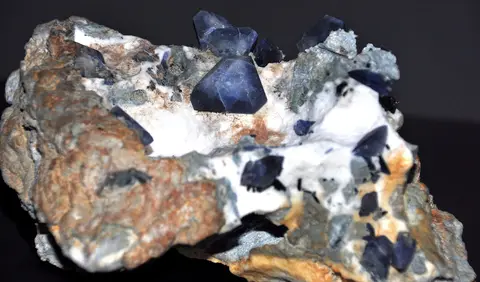
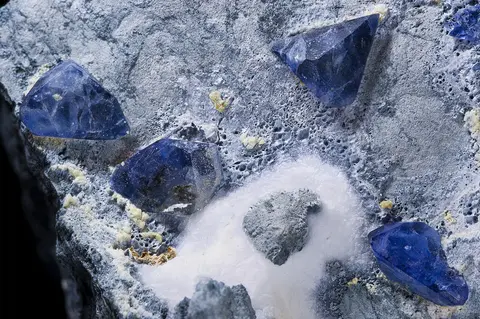
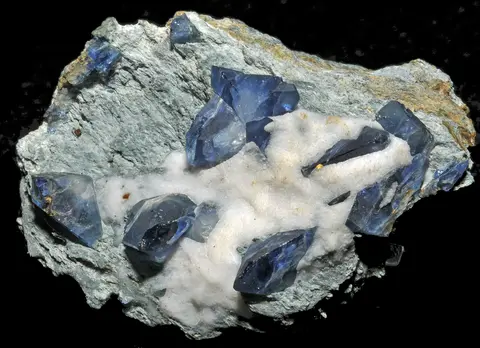
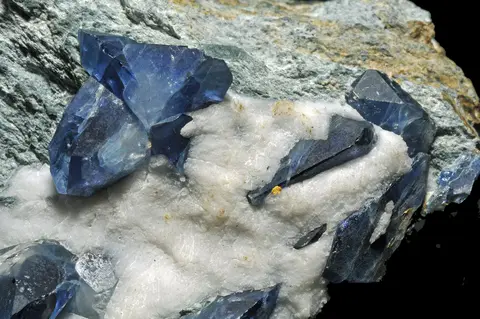
Benitoite is a barium titanium silicate (BaTiSi3O9) that forms flat triangular blue crystals. Gem material comes essentially from one deposit in San Benito County, California, and it is the official state gem of California.
Prices checked . Page updated .
Blueschist with benitoite-neptunite-joaquinite-natrolite vein (Franciscan Complex, Jurassic-Cretaceous; Middle Miocene vein mineralization, 12 Ma; Dallas Gem Mine, California, USA) 2 (25400412690). Photo: James St. John, CC BY 2.0, via Wikimedia Commons.
Benitoite HD. Photo: Didier Descouens, CC BY-SA 4.0, via Wikimedia Commons.
Benitoite, joaquinite-(Ce), natrolite. Photo: Parent Géry, CC BY-SA 3.0, via Wikimedia Commons.
Benitoite, natrolite. Photo: Parent Géry, CC BY-SA 3.0, via Wikimedia Commons.
What benitoite is worth
Not enough data. We have not yet seen 5 or more current dealer listings for benitoite in any one form, so we show no range rather than guess.
These are dealer asking prices: what shops list benitoite for, not what it sells for and not an appraisal. Selling to a dealer usually brings well below retail, because the dealer has to resell it at a margin.
How to identify benitoite
Triangular, flat crystals (trigonal dipyramids) in sapphire blue to pale blue or colorless, a shape almost no other blue mineral shows.
Glows a strong bright blue under shortwave UV light.
Strong fire in faceted stones, comparable to diamond, though often masked by the body color.
Strong pleochroism: colorless in one direction, blue in another.
At the classic locality it sits on white natrolite with black neptunite prisms and honey-brown joaquinite.
Hardness 6 to 6.5; scratches glass with effort but is scratched by quartz.
Where benitoite comes from
Benitoite Gem Mine (Dallas Gem Mine), San Benito County, California, USA
Type locality and the only significant source of gem crystals, found in 1907 and worked intermittently since.
Other San Benito County serpentinite occurrences, California
Small crystals of specimen interest only.
Magnet Cove, Arkansas, USA and Japan
Tiny crystals of specimen interest only, with no gem value.
Spinel is singly refractive, with no pleochroism and no facet doubling.
Spinel SG 3.6, similar
Octahedral crystals
Fake, dyed and treated benitoite
Blue sapphire, spinel, glass or synthetic stones sold as benitoite
Occasional
No blue glow under shortwave UV
Not from the San Benito County mine and no provenance
No lab report
Specimens with matrix from elsewhere or glued crystals
Occasional
Benitoite not sitting on natrolite with neptunite or joaquinite
Glue visible at the crystal base under a loupe
Is my benitoite real? Tests you can do at home
Shortwave UV fluorescence
In a dark room, shine a shortwave (254 nm) UV lamp on the stone; wear UV-blocking glasses and never look into the lamp.
Real
Strong, bright chalky blue glow.
Fake or lookalike
Sapphire, tanzanite, iolite and glass stay dark or glow weakly in other colors.
Crystal shape and association check
Look at the crystal outline and surrounding minerals with a loupe.
Real
Triangular crystals on white natrolite with black neptunite and brown joaquinite.
Fake or lookalike
Hexagonal or octahedral crystals, or quartz matrix, point to other minerals.
Pleochroism with polarized sunglasses
Rotate a polarizing lens over a transparent stone.
Real
Changes between blue and almost colorless.
Fake or lookalike
Spinel and glass show no change; tanzanite shows violet and brownish tones.
Specific gravity
Weigh in air and in water on a 0.01 g scale and divide (best on stones over a carat).
Real
About 3.65 to 3.68.
Fake or lookalike
Sapphire 4.0, iolite 2.6, tanzanite 3.35, glass about 2.5.
A stone that passes these tests is consistent with natural benitoite, not proven. For valuable pieces, a gem lab report settles treatment and origin.
Treatments
Acid etching of natrolite matrix (almost always)
Dilute hydrochloric acid dissolves the white natrolite covering the crystals to expose them; this is standard and expected for specimens. Visible as exposed crystals on remaining matrix; not considered a negative.
What moves the price of benitoite
Size. Most faceted benitoite is under a carat; clean stones over a carat are rare and rise steeply in value.
Color. Saturated sapphire blue brings much more than pale or colorless.
Clarity. Eye-clean stones are preferred; many crystals are included or zoned.
Specimen quality. Sharp, undamaged triangular crystals on natrolite with neptunite and joaquinite are classic display pieces.