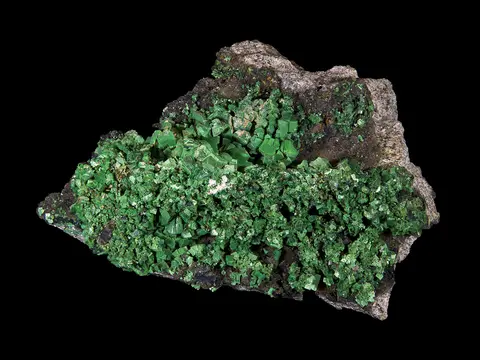
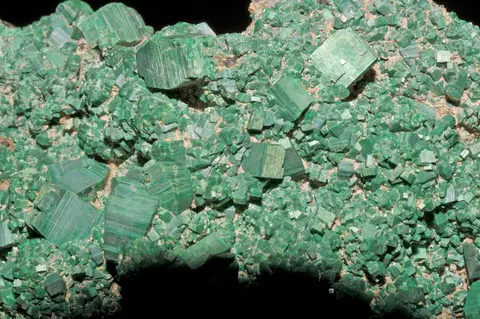
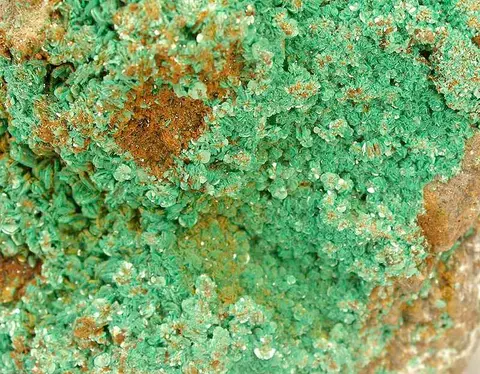
Torbernite is a hydrated copper uranyl phosphate, Cu(UO2)2(PO4)2·12H2O, that forms in the oxidized zones of uranium deposits. It grows as bright emerald-green square plates and is radioactive.
Not enough data. We have not yet seen 5 or more current dealer listings for torbernite in any one form, so we show no range rather than guess.
These are dealer asking prices: what shops list torbernite for, not what it sells for and not an appraisal. Selling to a dealer usually brings well below retail, because the dealer has to resell it at a margin.
How to identify torbernite
Bright emerald to grass-green square or rectangular tabular crystals
Thin plates stacked like mica, with a pearly sheen on flat faces
Very soft (hardness 2 to 2.5)
Does not fluoresce under UV, unlike its yellow-green cousin autunite
Registers clearly on a Geiger counter
Usually on granite, quartz or iron-stained matrix with other uranium minerals
Where torbernite comes from
Musonoi and Kolwezi, Katanga, DR Congo
Large, deep green crystals, among the finest known.
Margabal mine, Aveyron, France
Sharp green crystals on matrix, popular with European collectors.
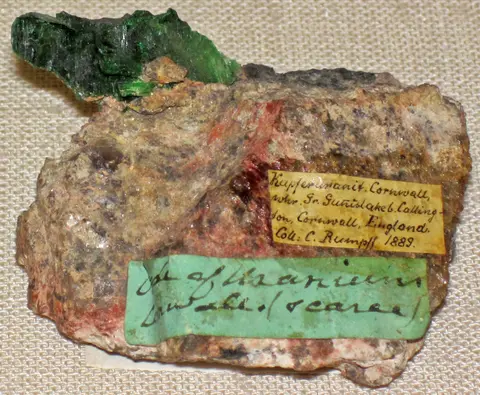
Cornwall, England
Classic old locality, including Gunnislake and the Redruth area.
Mount Painter, South Australia
Uranium deposits with torbernite on matrix.
Schneeberg and Johanngeorgenstadt, Saxony, Germany
Autunite glows bright yellow-green under UV; torbernite stays dark.
Autunite is calcium-based and yellow to yellow-green
Similar square plates
Both are radioactive
Metatorbernite
Metatorbernite is the dehydrated form and looks almost identical; it usually needs lab work to tell apart.
Slightly harder and denser
Many old torbernite specimens have partly altered to it
Zeunerite
Zeunerite is the arsenate equivalent and cannot be separated from torbernite without lab analysis.
Same color and habit
Usually occurs with arsenic minerals
Green mica (fuchsite)
Fuchsite flakes are flexible and not radioactive.
Duller green
Silvery sheen
Fake, dyed and treated torbernite
Metatorbernite or zeunerite sold as torbernite
Common
Usually not detectable at home
Ask for analysis on important pieces
Is my torbernite real? Tests you can do at home
UV torch
Shine a longwave UV torch on the crystals in the dark.
Real
No fluorescence.
Fake or lookalike
Autunite glows bright yellow-green.
Geiger counter
Hold a Geiger counter near the specimen without touching it.
Real
Counts rise well above background.
Fake or lookalike
Green mica, glass and dyed material read background.
Loupe on crystal habit
Look at the crystals with a 10x loupe without touching.
Real
Square plates in stacks with a pearly sheen.
Fake or lookalike
Mica forms flexible hexagonal flakes.
A stone that passes these tests is consistent with natural torbernite, not proven. For valuable pieces, a gem lab report settles treatment and origin.
Treatments
Lacquer or sealing (occasional)
Sometimes applied to slow dehydration and flaking; can reduce appeal. Glossy film under a loupe.
What moves the price of torbernite
Crystal size and color. Large, deep emerald-green, sharp crystals bring the most.
Condition. Pieces that have not cracked or dulled from dehydration are preferred.
Locality. Congo and fine French material are top tier.
Matrix. Crystals spread on contrasting matrix display better.
Shipping restrictions. Radioactive material is harder to ship, which limits buyers.
Care and safety
Radioactive. Keep in a sealed container in a ventilated area away from living spaces, handle briefly and wash hands, never grind, break or inhale dust, and keep away from children.
Store cool and away from heat and dry air to slow dehydration to metatorbernite. Keep in a closed container.