What puddingstone is worth
Not enough data. We have not yet seen 5 or more current dealer listings for puddingstone in any one form, so we show no range rather than guess.
These are dealer asking prices: what shops list puddingstone for, not what it sells for and not an appraisal. Selling to a dealer usually brings well below retail, because the dealer has to resell it at a margin.
How to identify puddingstone
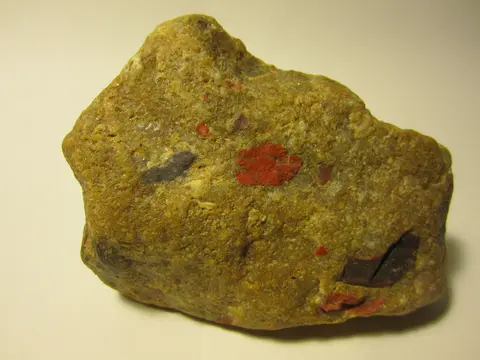
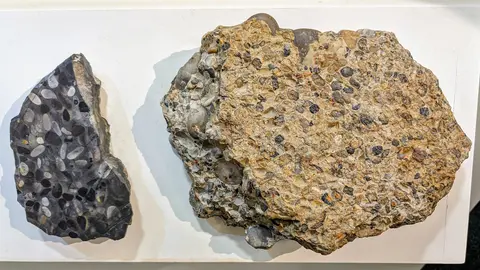
- Rounded, water-worn pebbles set in a finer-grained matrix, like raisins in a pudding
- Michigan type: red, brown, black and yellow jasper pebbles in white to gray quartzite
- Hertfordshire type: brown, black and cream flint pebbles in a sandy silica cement
- Pebbles and matrix are both hard; a good piece breaks through the pebbles rather than around them
- Takes a polish across both pebbles and matrix when the cement is silica
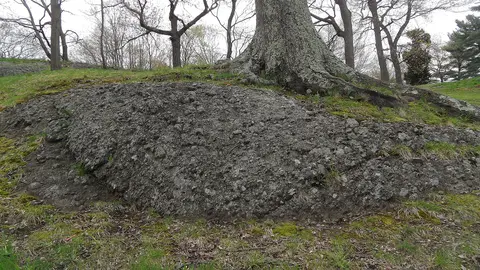
- Found loose as glacial boulders and cobbles in the Great Lakes region
Where puddingstone comes from
- Drummond Island and the eastern Upper Peninsula, Michigan, USA
- Glacial cobbles and boulders of jasper puddingstone, widely collected on beaches and in fields.
- St. Joseph Island and Bruce Mines area, Ontario, Canada
- The bedrock source of the Michigan type, in Paleoproterozoic Lorrain Formation quartzite.
- Lower Michigan and Great Lakes beaches
- Glaciers spread pieces south; finds occur far from the source.
- Hertfordshire, England
- Flint puddingstone from Paleogene deposits, used historically for querns and folklore stones; also found in neighboring counties.
Puddingstone lookalikes
Breccia has sharp, angular fragments; puddingstone pebbles are rounded.
- Both are silica rocks of similar hardness
- Clast shape is the main difference
Carbonate-cemented conglomerate
A drop of vinegar fizzes on calcite cement; silica-cemented puddingstone does not.
- Softer matrix, scratched by a knife
- Does not polish evenly
- Crumbles at edges
Concrete with gravel
Concrete has gray cement that a knife scratches and often shows air bubbles and mixed modern gravel.
- Cement fizzes in vinegar
- Pebbles are random rock types, not mainly jasper
Fake, dyed and treated puddingstone
Ordinary conglomerate or breccia sold as puddingstone
Common
- Angular clasts
- Soft or crumbly matrix
- Gray, dull pebbles without jasper colors
Tumbled or slabbed pieces with a lacquer or wax shine
Occasional
- Gloss sits on top of the surface
- Pits and soft matrix still look shiny
Is my puddingstone real? Tests you can do at home
-
Look at clast shape
Examine the pebbles on a broken or cut face with a loupe.
- Real
- Rounded to oval pebbles.
- Fake or lookalike
- Breccia shows sharp, angular fragments.
-
Vinegar on the matrix
Put a drop of household vinegar on the matrix between pebbles.
- Real
- Silica-cemented puddingstone does not fizz.
- Fake or lookalike
- Carbonate-cemented conglomerate and concrete fizz.
Can leave a small mark.
-
Scratch the matrix against glass
Try to scratch a glass bottle with a sharp edge of matrix.
- Real
- Quartzite and silica matrix scratch glass.
- Fake or lookalike
- Soft cements do not.
Can leave a small mark.
A stone that passes these tests is consistent with natural puddingstone, not proven. For valuable pieces, a gem lab report settles treatment and origin.
Treatments
- Polishing and tumbling (common)
- Brings out pebble colors; well-polished pieces sell better than rough. Not a concern; just check for applied wax or lacquer.
What moves the price of puddingstone
- Pebble color and contrast. Bright red jasper pebbles in clean white matrix are the most wanted.
- Pebble density. Many evenly spaced pebbles beat sparse ones.
- Polish quality. A smooth polish without undercutting adds value.
- Size. Large polished boulders and spheres are sought for display.
- Origin. Authentic Michigan, Ontario or Hertfordshire material is preferred over generic conglomerate.