Larvikite vs yooperlite
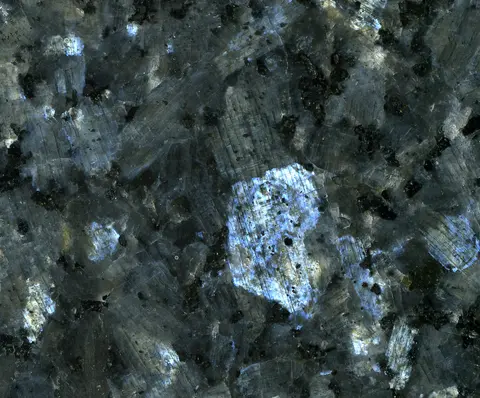
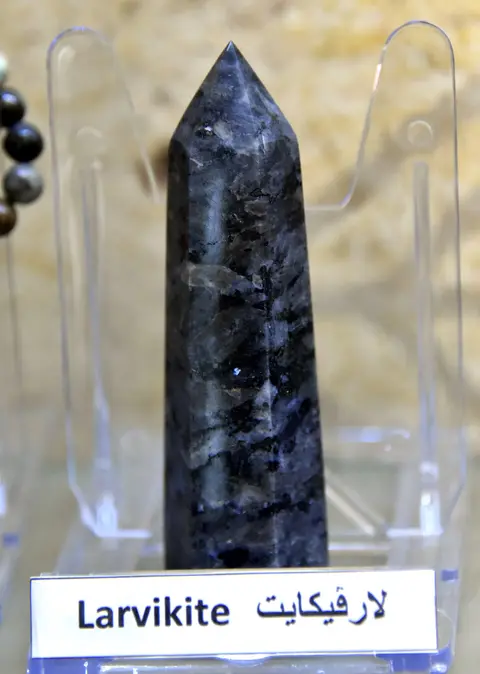
Larvikite shows blue-gray flashes of schiller in daylight and does not glow orange under UV.
Side by side
| Property | Larvikite | Yooperlite |
|---|---|---|
| Hardness (Mohs) | About 6 | 5.5 to 6 |
| Specific gravity | About 2.6 to 2.8 | 2.27 to 2.33 |
| Luster | Vitreous on polished surfaces | Vitreous to greasy |
| Streak | White | White |
| Crystal system | Monoclinic (orthoclase, sanidine) or triclinic (microcline, plagioclase) | Cubic (isometric) |
| Cleavage | Perfect in one direction, good in a second, at or near 90 degrees | Poor, dodecahedral |
| Refractive index | 1.518 to 1.526 (orthoclase moonstone); 1.559 to 1.572 (labradorite) | 1.483 to 1.487 |
| Formula | KAlSi3O8 (potassium feldspar); NaAlSi3O8 to CaAl2Si2O8 (plagioclase series) | Na8(Al6Si6O24)Cl2 |
How to tell them apart
- Also a feldspar-rich syenite type rock
- Polished larvikite is common as tiles and beads
Photos of each
Larvikite


Yooperlite
More on each: larvikite value and identification and yooperlite value and identification.